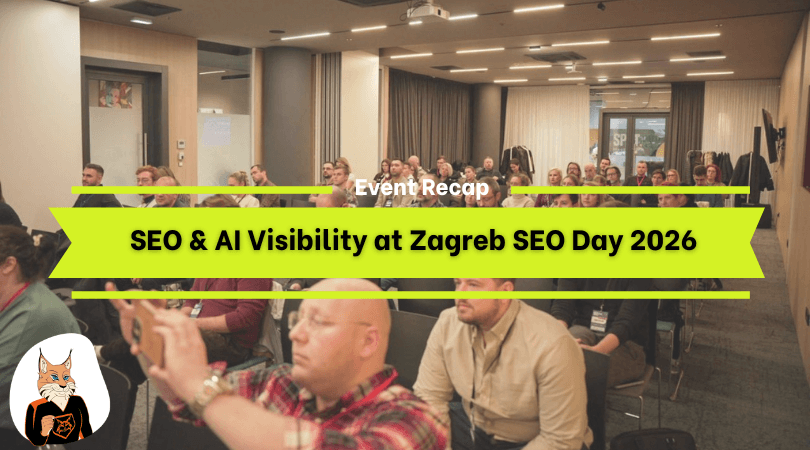
On October 30, 2026, I spoke at Zagreb SEO Day, the full-day tactical conference run by the team behind Croatia SEO Summit: one room, around 100 people, nine sessions, and no filler. Every talk was built around what is working right now, not what worked two years ago.
My talk was The Great Blogging Collapse: What 100 Blogs Tell Us About Surviving AI Search, showing what happened to 100 six-figure blogs between 2022 and 2026, what the survivors have in common, and what kind of content survives AI summarization.
The day kept me glued to my chair. When you do SEO yourself, you can quickly tell who’s sharing hands-on experience and who is reciting slides. This lineup was the first kind. Below is a recap of my talk, a session-by-session summary of the whole day, and the threads that connected them.
A big thank you to Croatia SEO Summit and the organizing team: Tin Đudajek, Krešimir Ćorluka, and Filip Đudajek for putting it together, and to WESPA Business & Lounge for hosting.
The format: 30 minutes, 5 minutes for questions
The format was a great call: 9 sessions of 30 minutes each, with 5 minutes reserved for questions. That's long enough to show real data and short enough that nobody pads. The Q&A slots mattered too, as the questions from the room were sharp, specific, and clearly came from people who run sites for a living.
The ticket included lunch, coffee breaks, evening networking drinks, and an after-party that kept conversations going well into the evening.
My talk: The Great Blogging Collapse
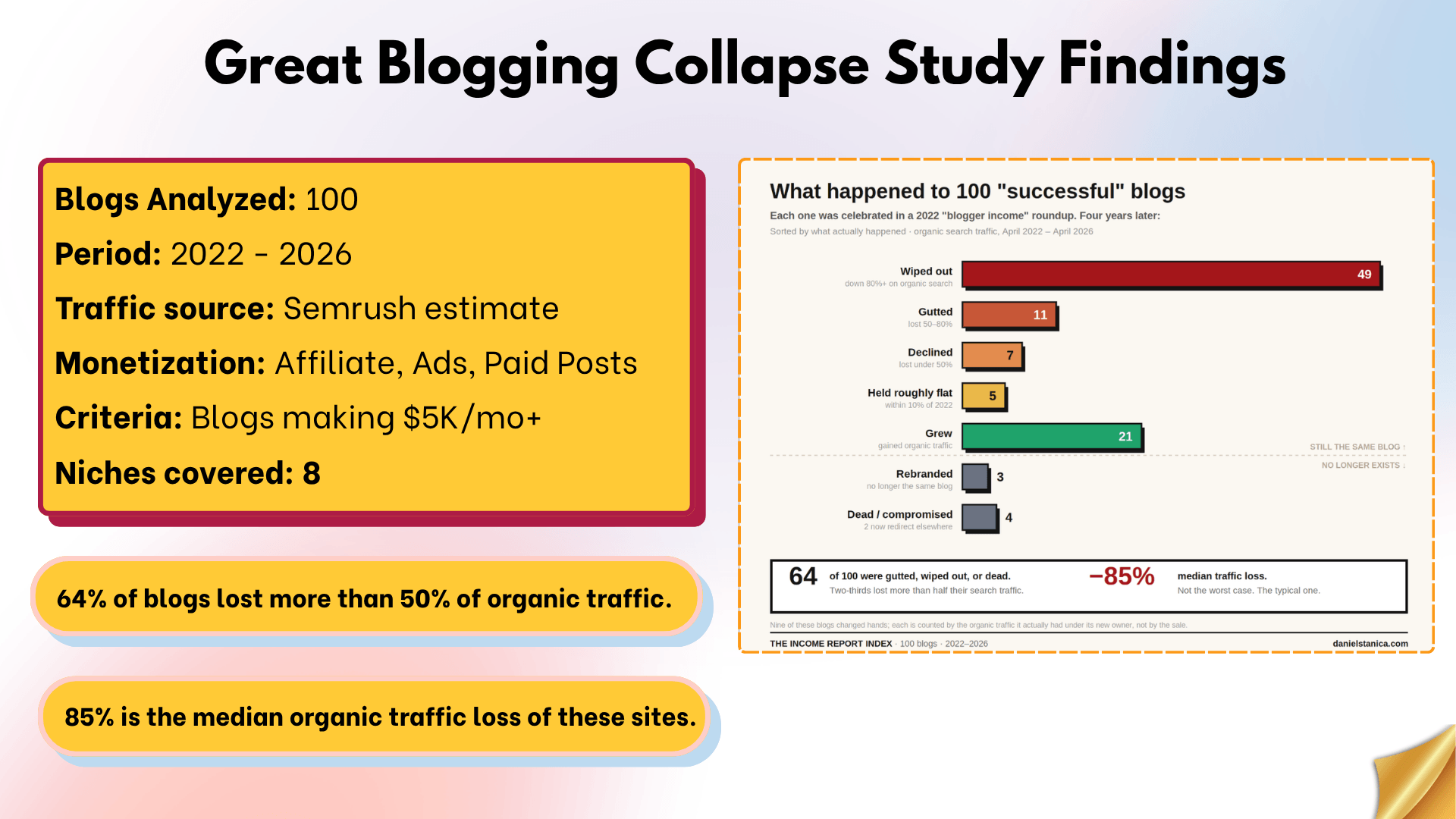
Between April 2022 and April 2026, I tracked 100 blogs publicly celebrated in "bloggers who make six figures" roundups. A fixed cohort, followed through the arrival of AI Overviews, the rise of assistant-led search, and the change in search behavior that came with both.
The headline numbers:
- The median blog lost 85% of its organic traffic. That's the typical outcome, not the worst case.
- Two-thirds lost more than half of their search traffic, and 55 of the 100 were gutted, wiped out, or dead.
- 20 sites lost 99% or more, and 12 now sit at zero organic visits.
- Only 21 of the 100 kept growing.
Which categories fell hardest
The niche split was brutal. Finance (−99% median), Fashion (−95%), Health and make-money / entrepreneurship (−93%), and Lifestyle (−90%) were hit hardest. Travel fell 74% and Food 44%, while Parenting and DIY/Crafts held or grew — mostly small personal blogs rebuilding from a low base.
Where the traffic went
The traffic didn't disappear; it was absorbed. AI Overviews now show on roughly 80% of Google searches, zero-click searches are the majority, and the answer engines increasingly cite sources outside the classic top 10, with Reddit, YouTube, and Wikipedia above all.
What the 21 survivors share
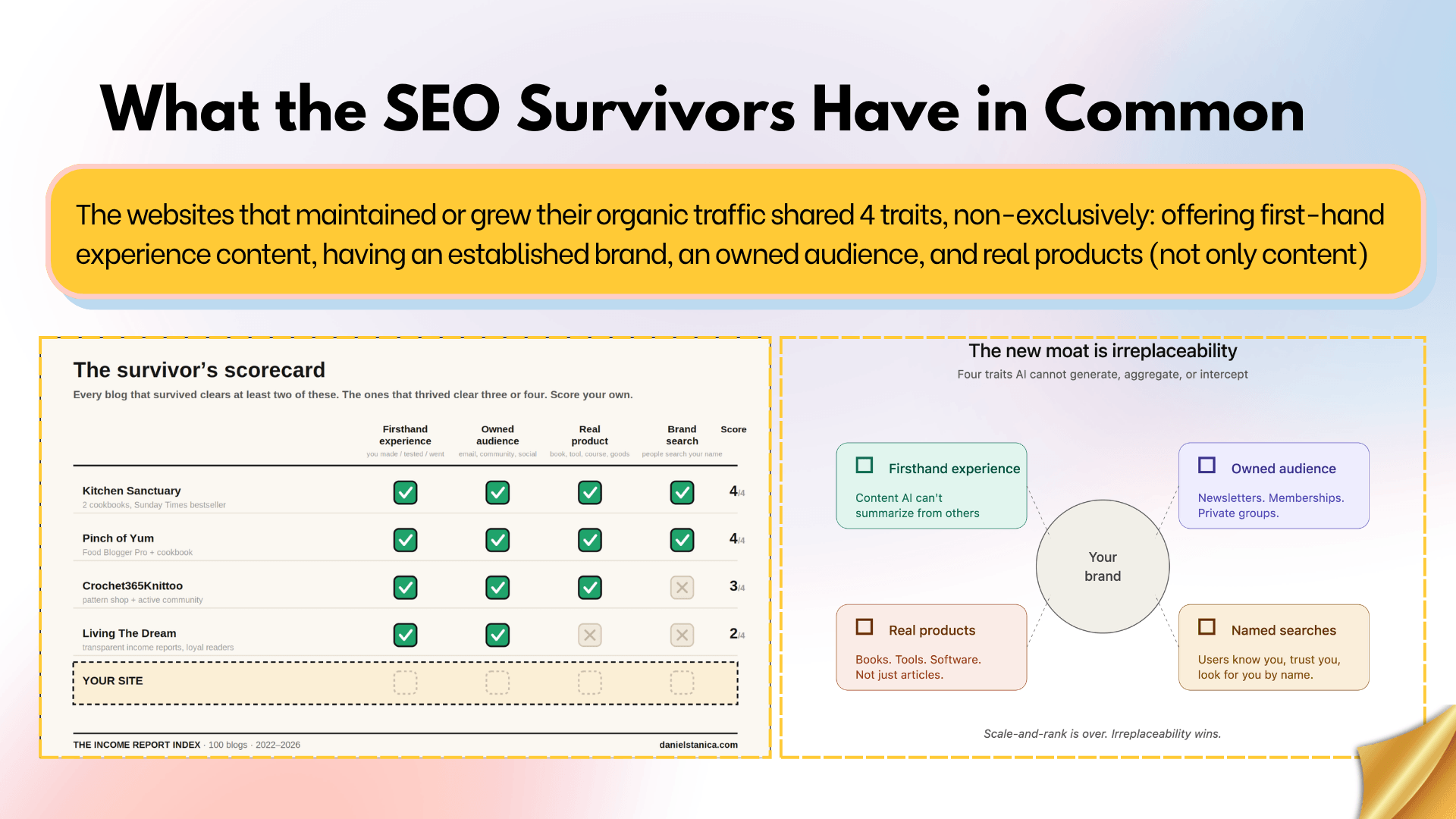
The useful half of the talk. Every survivor had at least two of these four traits, and the top performers had three or four:
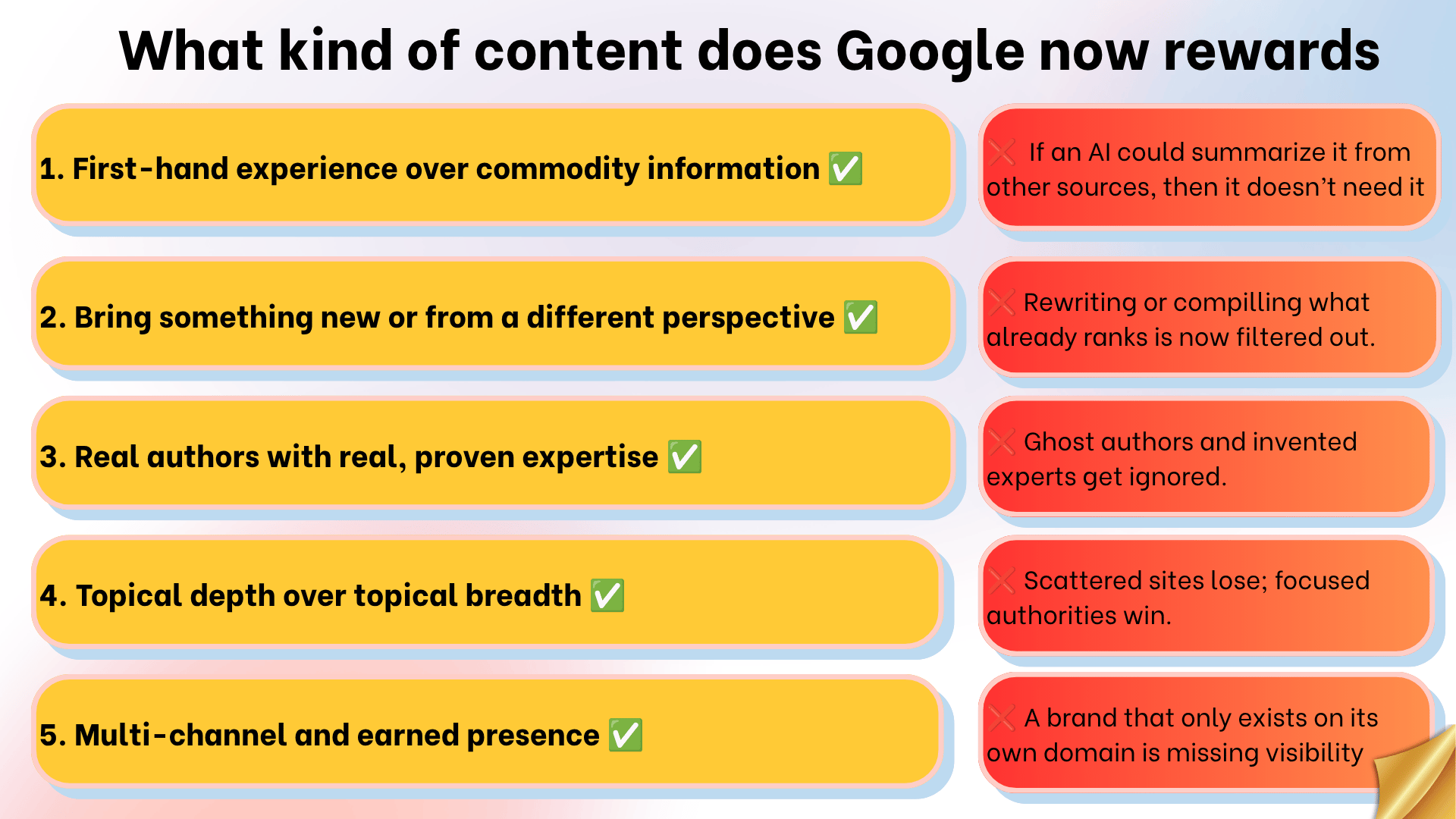
- Firsthand experience — content AI can't produce or summarize away because it documents the doing: the tested recipe, the finished project, the place actually visited.
- An owned audience — distribution the owner controls (newsletter, YouTube, community), so Google isn't the only door in.
- A real product — something the site sells or builds, not just content wrapped around affiliate links.
- A brand people search for by name — direct demand that doesn't depend on ranking for generic queries.
The idea that ties them together is irreplaceability: does the reader need you specifically to get the result, or would an AI summary do the job? If a summary is enough, the click is gone.
Content that survives AI summarization
The last part of the talk turned the findings into a framework for content that Google and AI answer engines rank, cite, and recommend, and a way to measure whether your own properties are on the surviving side of the line: compare your organic traffic at two points in time, check what share of total traffic search still represents, see whether other channels are offsetting the loss, and audit how much of your content an AI answer could replace.
What I recommend you do with your blog
Your blog isn't dead. The format is. A blog that's only a collection of articles waiting for Google clicks is the model that collapsed.
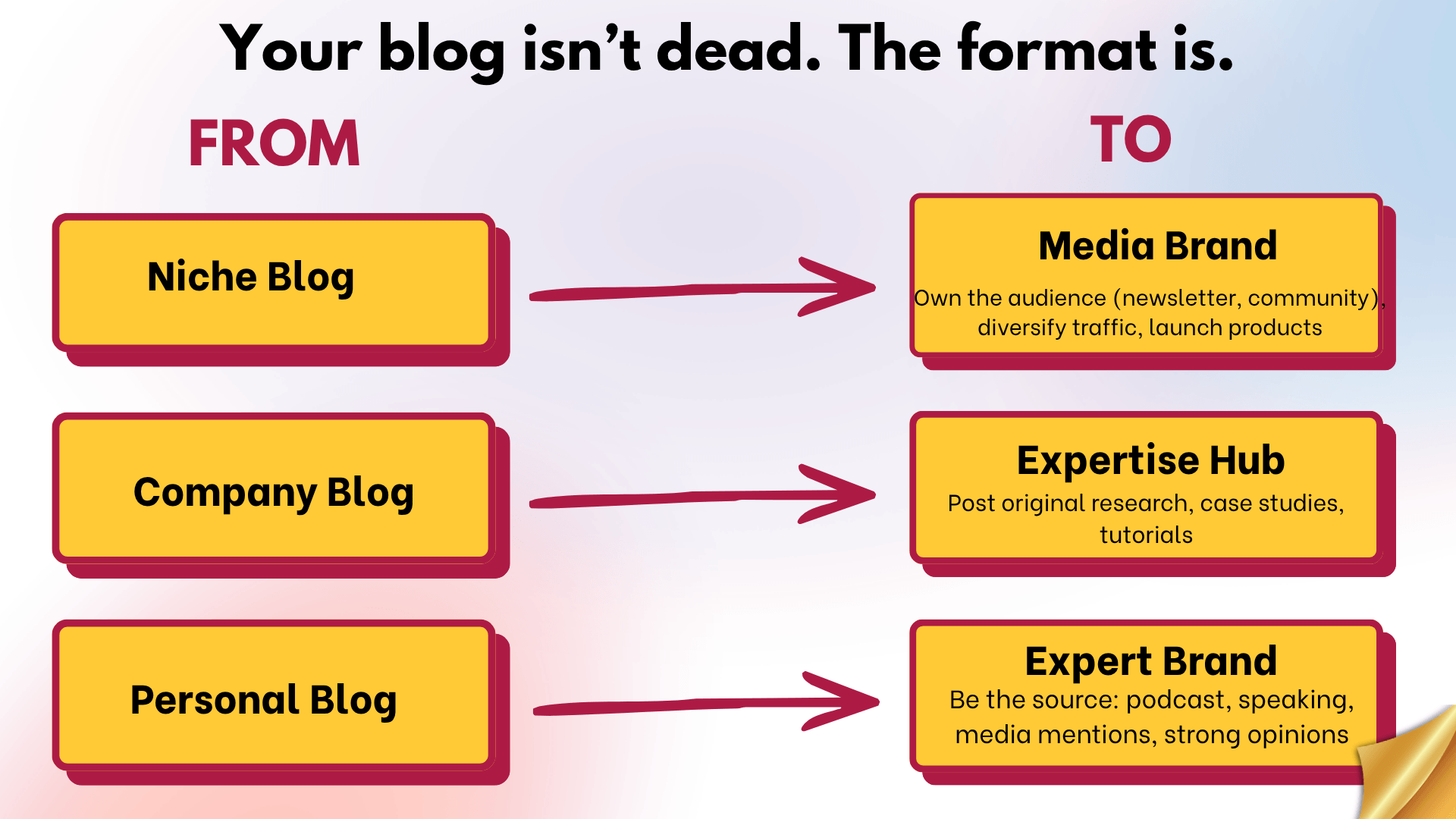
My recommendation is to turn the blog into something an AI summary can't replace. Which direction depends on what kind of blog you run:
- Niche blog → Media brand. Own the audience with a newsletter or a community, so you don't depend on search for every visit. Spread your traffic across several channels, and launch your own products instead of living only on ads and affiliate commissions.
- Company blog → Expertise hub. Stop publishing generic articles that any AI can summarize. Publish original research, case studies, and tutorials built on your own data and work. That's the material AI engines cite, and it's what buyers need to trust you.
- Personal blog → Expert brand. Be the source. Go on podcasts, speak at events, get mentioned in the media, and take clear positions. When people search for your name, or AI recommends you for the topic, the blog becomes the home base for that reputation.
All three map back to the survivor traits: firsthand experience, an owned audience, a real product, and a brand people look for by name. Pick the one that fits your blog and start building the trait you're missing.
Session-by-session recap
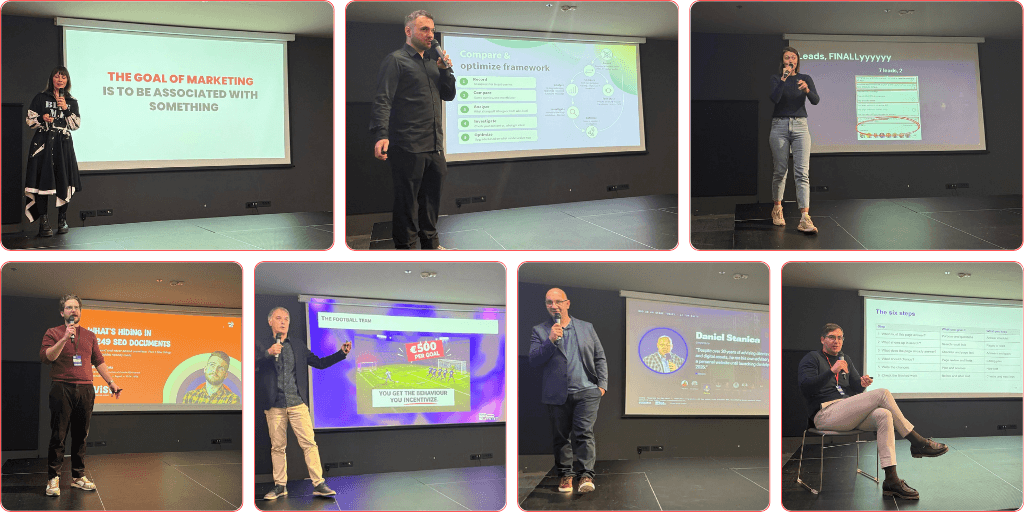
1. Barbara Slade Jagodić — Search Everywhere Optimization
Barbara Slade Jagodić (Slade.hr) opened the day with a talk on Search Everywhere Optimization and why branding now matters as much for AI search as for classic SEO. A strong opener, and it set up a theme that kept coming back all day.
2. Kliment Stamenkov — A framework for AI optimization
Kliment Stamenkov (Flow) shared his framework for AI optimization, backed by what he's seeing with SaaS clients: practical, process-driven, and grounded in client work rather than theory.
3. Daniel Stanica — The Great Blogging Collapse
My session, recapped above: what happened to 100 six-figure blogs, what the 21 survivors share, and what content survives AI summarization.
4. Adrijana Vujadin — Premium leads from LinkedIn
Adrijana Vujadin walked through her system for getting premium leads and clients from LinkedIn — and why most LinkedIn posts are done wrong: they chase likes and recognition instead of solving the client's actual pain points.
5. Robert Petković — Google Analytics myths
Robert Petković (Analytics & Co) debunked common Google Analytics myths and showed how to read the charts correctly at first glance — the kind of session that saves you from bad decisions built on misread data.
6. Marko Hrnjak — The Croatia AI Index
Marko Hrnjak (Risely Digital) presented the Croatia AI Index: how Croatians use AI tools and what they search for. One insight stood out — for some terms, the answers differed depending on whether you asked in Croatian, English, or German. For anyone doing AI visibility work across markets, that's a big deal.
7. Marko Pacar — Researching content for search intent
Marko Pacar proposed a framework for researching and creating content that answers users' search intent and queries as well as possible.
8. Krešimir Ćorluka — 182 SEO tactics that held water
Krešimir Ćorluka compiled more than 30,000 SEO tests and guides to find out which tactics actually work. 182 tactics held water, and he shared them with the room. Easily one of the most data-heavy sessions of the day.
9. Barry Adams — Technical SEO for AI visibility
Barry Adams closed with technical SEO fundamentals and what actually matters for AI visibility: crawlability, page speed, content structure, and navigation structure. He also debunked a few myths along the way — llms.txt included.
What tied the day together
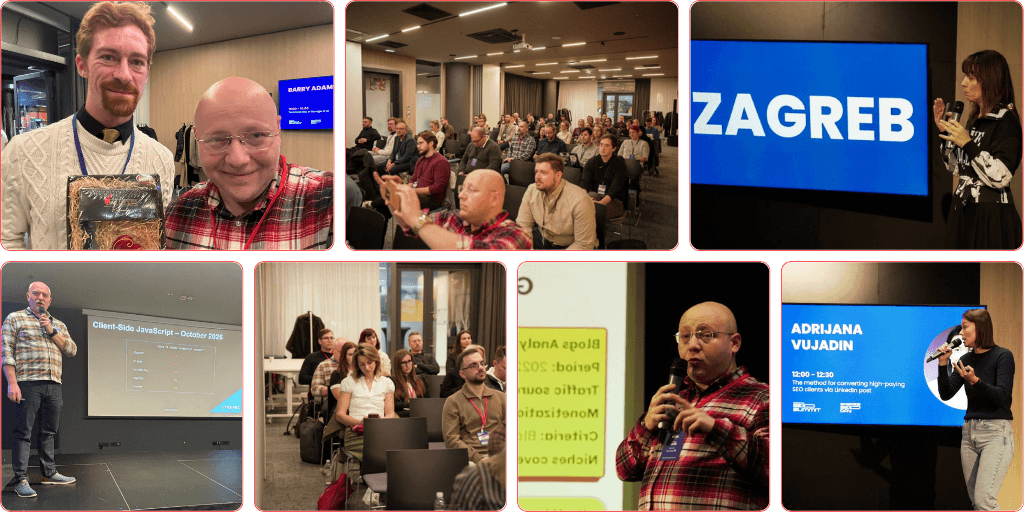
Nine speakers, different angles, but the same few conclusions kept surfacing:
- Brand is now a ranking factor in practice. Barbara's opener, my survivor data, and the AI visibility talks all pointed the same way: being known and searched for by name is what keeps you visible when the click disappears.
- Fundamentals still win. Barry's technical session and Krešimir's 182 tested tactics reminded us that crawlability, structure, and speed still matter, even as the interface changes.
- Evidence beats hype. Tested tactics, real client data, a national AI index, a 100-blog cohort — the best sessions were built on measurement, not opinion.
- AI answers aren't one market. Marko Hrnjak's language finding means AI visibility has to be measured per language and per market, not assumed.
- Solve the pain point. Whether it's a LinkedIn post or a blog article, content that answers a real problem outlives content written to be liked.
Slides and next steps
- Slides: The Great Blogging Collapse — download the slides (PDF)
- The full study: The Great Blogging Collapse — the dataset, niche breakdown, and methodology
- Organizers: follow Croatia SEO Summit for their next event
Conclusion
Thank you to all the speakers for being open about what actually works in their own practice and, most of all, thank you to everyone who attended and asked such sharp questions. If you were in the room and want to dig into the data for your own sites, get in touch.
Zagreb delivered exactly what it promised: one room, no filler, and a full day of what's working in SEO and AI Visibility right now.
See you at the next one!