
For more than a decade, one of the most rewarding blueprints for making money online was to “start a blog.“ The recipe was pretty straightforward: publish helpful content, rank it on Google, and monetize that traffic with affiliate marketing and ads. Course providers such as Authority Hacker and Matt Diggity promoted it for years. As proof of success, many bloggers shared monthly income reports where they explained their growth pillars.
However, in 2026, this business model collapsed.
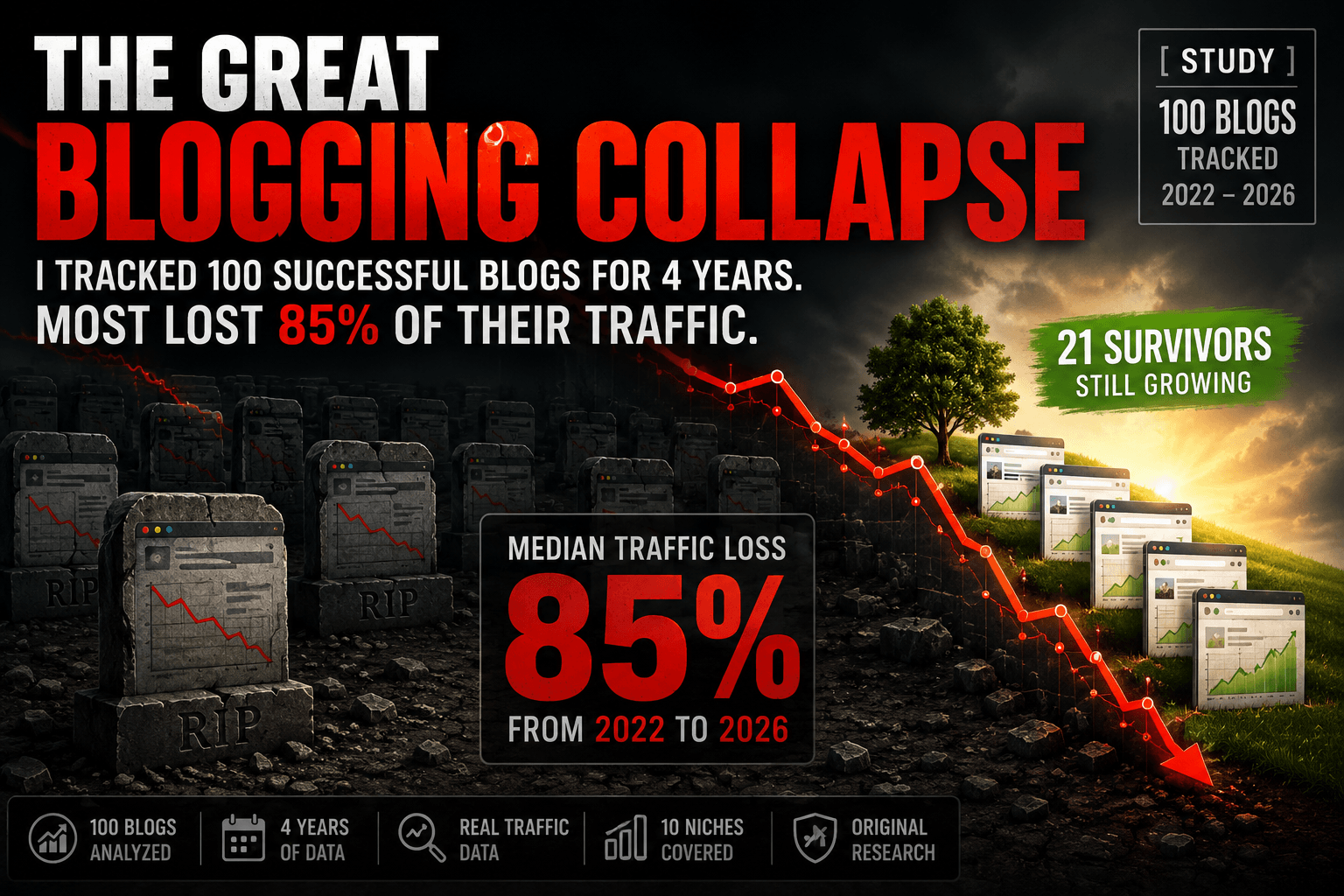
I'm Daniel Stanica, and I've spent the last 20+ years building, buying, and selling content sites, including one of the blogs in the dataset you're about to read. I reviewed 100 past success stories and tracked how their organic search traffic changed from 2022 (when I first tracked their income) to 2026. The hard truth is that the vast majority have now lost 85% of the traffic. However, 21 of the 100 blogs are still growing, and I'm going to share with you today what those 21 have in common.

Key Takeaways:
- The median successful blog lost 85% of its Google search traffic.
- More than half of the blogs experienced catastrophic declines.
- Only 21 out of 100 blogs continued to grow, and I show what characteristics they share.
- Experience that can’t be AI-summarized became the biggest competitive advantage: recipes, DIY projects, travel experiences;
- Search should be treated as an acquisition channel within the broader marketing mix, not as the business itself.
- The era of building websites solely for Google traffic and monetizing them through ads and affiliate marketing has ended.
How I built the 100 blogs list
These hundred authority sites and blogs were chosen back in 2022 as they appeared in “bloggers who make six figures” roundups that the entire creator economy circulated as evidence that the model was real and profitable. Here you can see the list created in 2022 with the income reports linked.
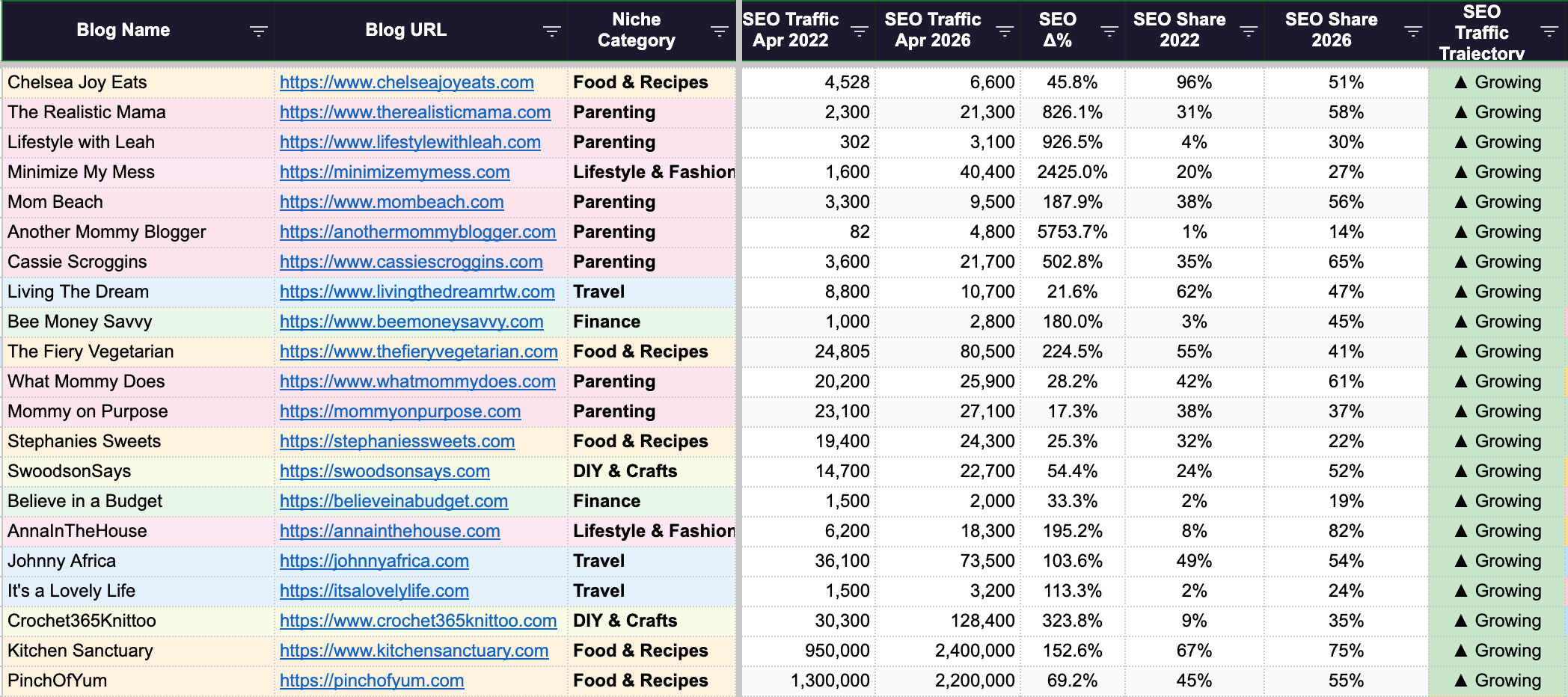
View the Google Sheet listing 100 blogs, along with traffic metrics.
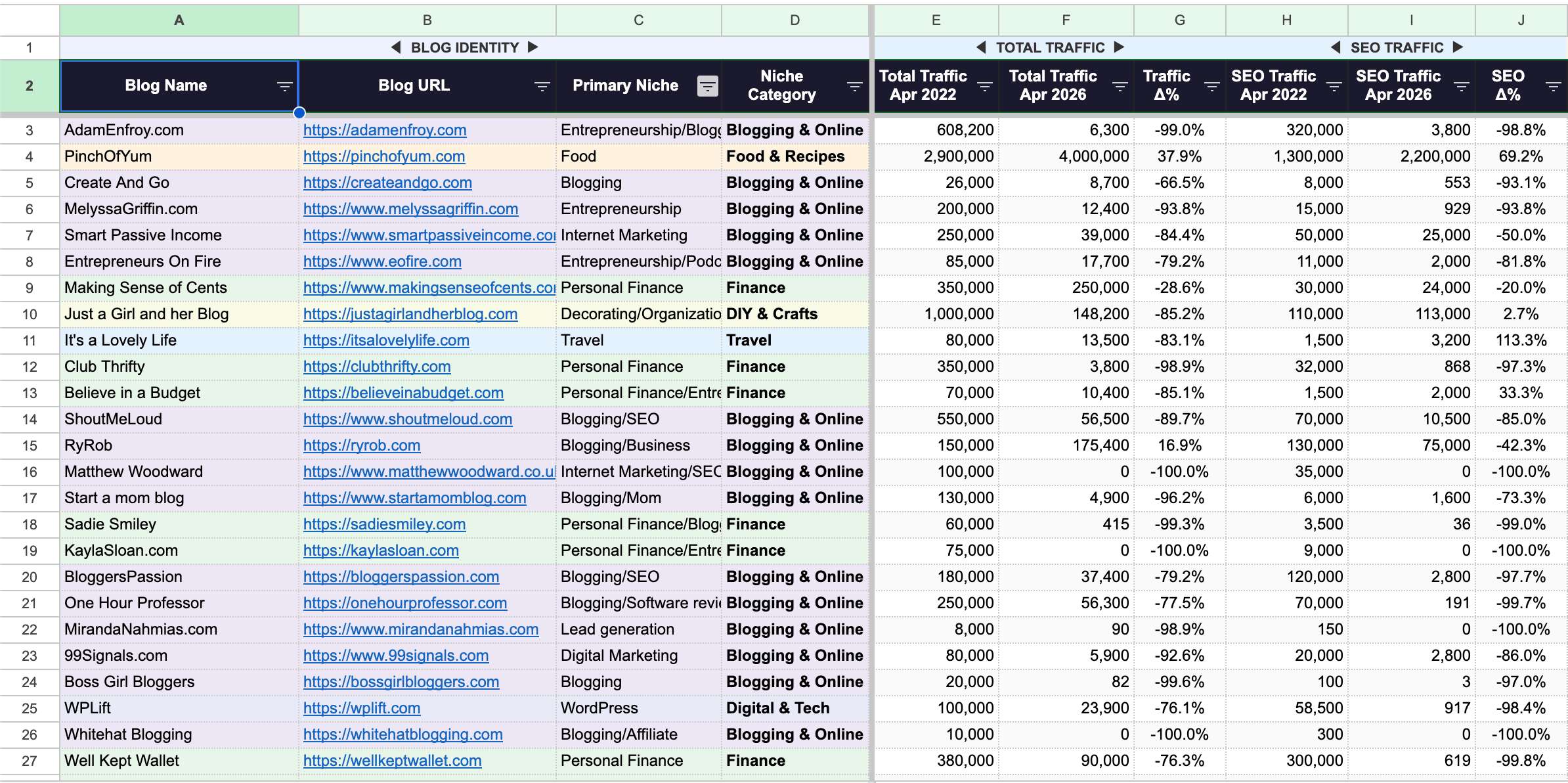
View the Google Sheet listing 100 blogs, along with traffic metrics. Feel free to use this list in your own AI research to identify blogs in your niche, which blogs are growing, etc.
If you tried to start a blog between roughly 2015 and 2022, most probably you read blog income reports as they were the proof of concept and held up to a generation of aspiring small publishers as this is what winning looks like, and you can do it too.
However, in hindsight, the model was a single, large, leveraged bet that Google would be the middleman, sending free clicks indefinitely to publishers in exchange for content. However, since 2023, Google has called the bet, and websites that leveraged this model became a liability rather than an asset. I know this firsthand, because I was holding a couple of these blogs.
What and how I measured in the study
This is a cohort study, not a representative sample. I am not claiming that two-thirds of all blogs on the internet lost their traffic. I am claiming something narrower and harder to wriggle out of: of the specific blogs publicly celebrated as the model's biggest winners, two-thirds lost the majority of their traffic.
So here is exactly what information I grabbed for each business blog in the list, besides the usual details like name, URL:
- Niche Category - All 100 blogs are grouped in the following 10 main niches: Blogging & Online, Food & Recipes, Finance, DIY& Crafts, Travel, Digital & Tech, Parenting, Lifestyle and Fashion, Health & Wellness, Other
- Total Traffic April 2022 & April 2026 - Total traffic (direct, organic, referral, paid, etc) the blog is receiving monthly, estimated by Semrush for April 2022 and April 2026
- Total Traffic Delta - How much the total traffic figure changed from April 2022 to April 2026
- SEO Traffic April 2022 & 2026 - The organic search traffic the blog is receiving monthly, estimated by Semrush for April 2022 and April 2026
- SEO Traffic Delta - How much the SEO traffic figure changed from April 2022 to April 2026
- SEO Share 2022 & SEO Share 2026 - How much the SEO traffic represents from the total traffic in April 2022 and April 2026
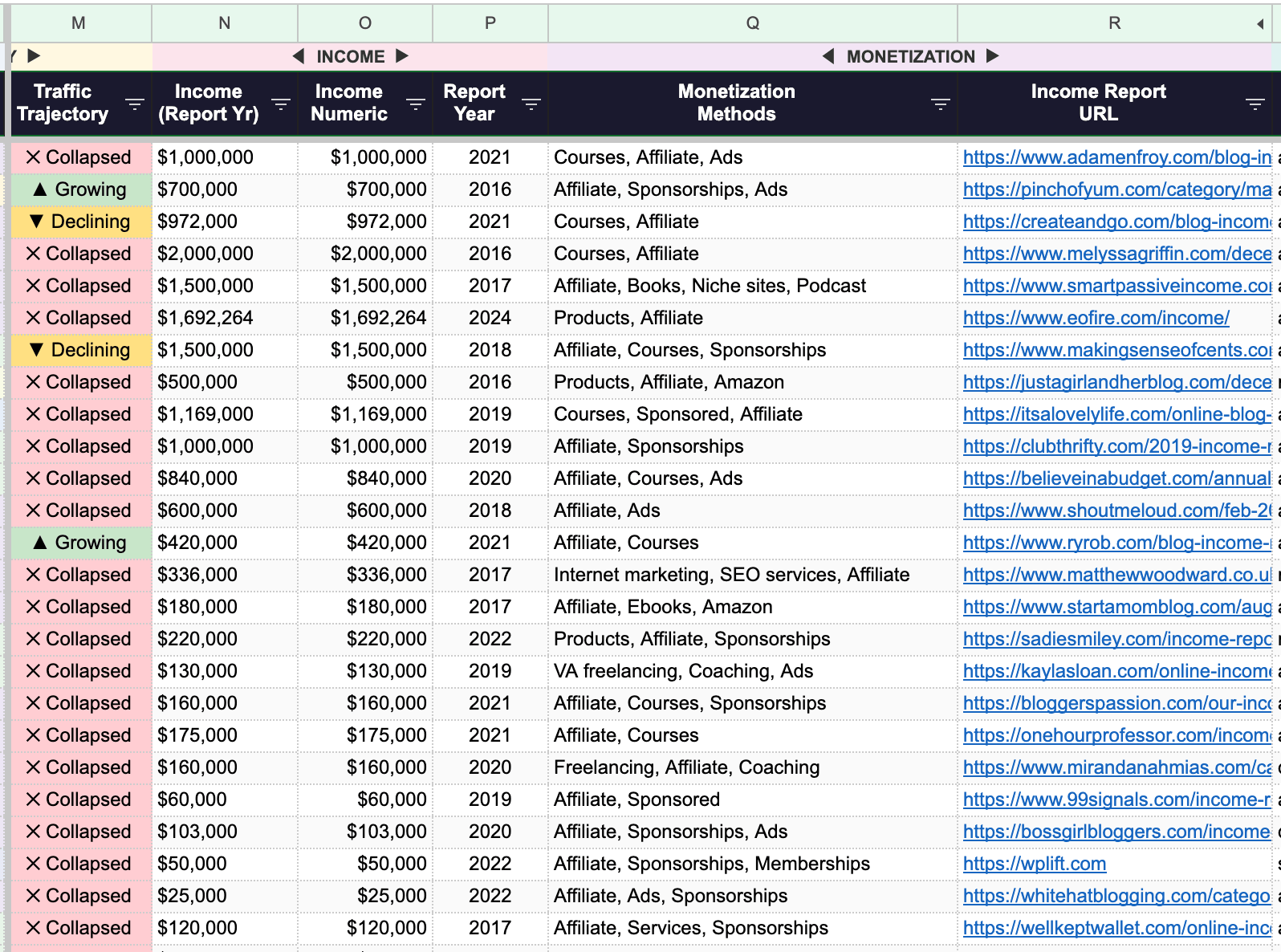
- Traffic & SEO Traffic Trajectory - What happened with the traffic and SEO traffic of the website, grouped into 4 categories: Collapsed, Growing, Declining, and Stable
- Income report + URL - Last available income report to classify the blog
- Monetization Methods - The main monetization methods the blogger was using were gathered by checking the website and income reports
- Status April 2026 - The current status of the blog: Alive, Dead, Rebranded, Sold, Unverified
- HCU Impact - How was the blog impacted by the HCU updates: Severely Hit, Hit, Unaffected
- New Brand - If the blog transitioned to a new brand, I list it here
I measured and estimated monthly organic search traffic at a 2022 baseline and a 2026 endpoint. Organic search specifically, because that is the channel Google's algorithm and AI answers actually touch.
A site can lose all its search traffic and still keep a thriving newsletter, a powerful brand that people type directly rather than search for, or a YouTube channel that drives traffic; when that happens, I flag it because it completely changes the interpretation.
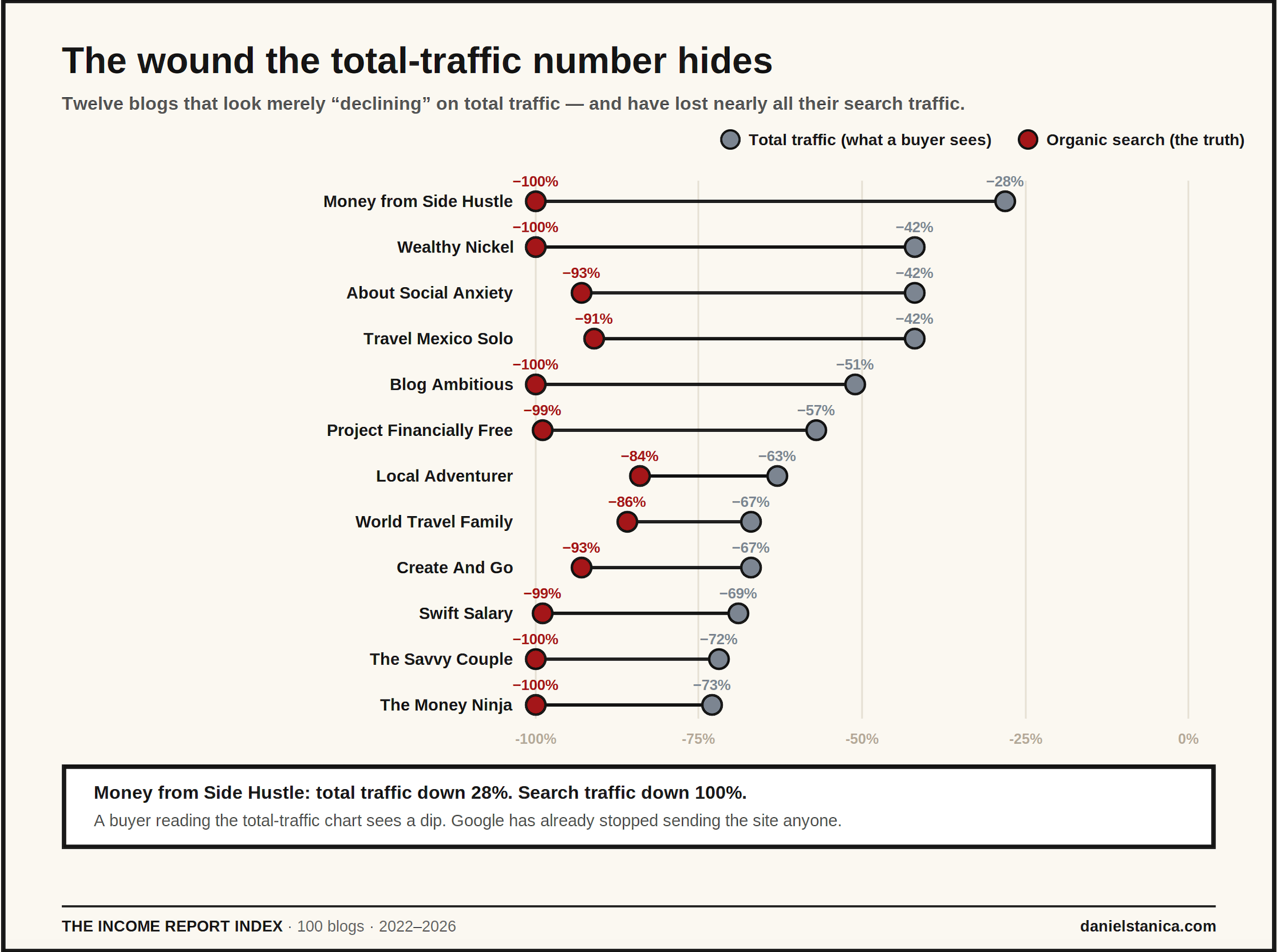
One constraint during my research was that I was working with third-party estimates. The traffic figures (total and organic) are estimates from the Semrush tool.
However, when a site goes from 950,000 to 8,600, the exact figure doesn't change anything. Every finding here rests on movements large enough that no plausible estimation error changes the conclusion. A site that "lost 90%" might have lost 87% or 93%. It did not hold steady.
The Search Traffic Carnage Explained
I sorted the hundred blogs by what actually happened to each one:
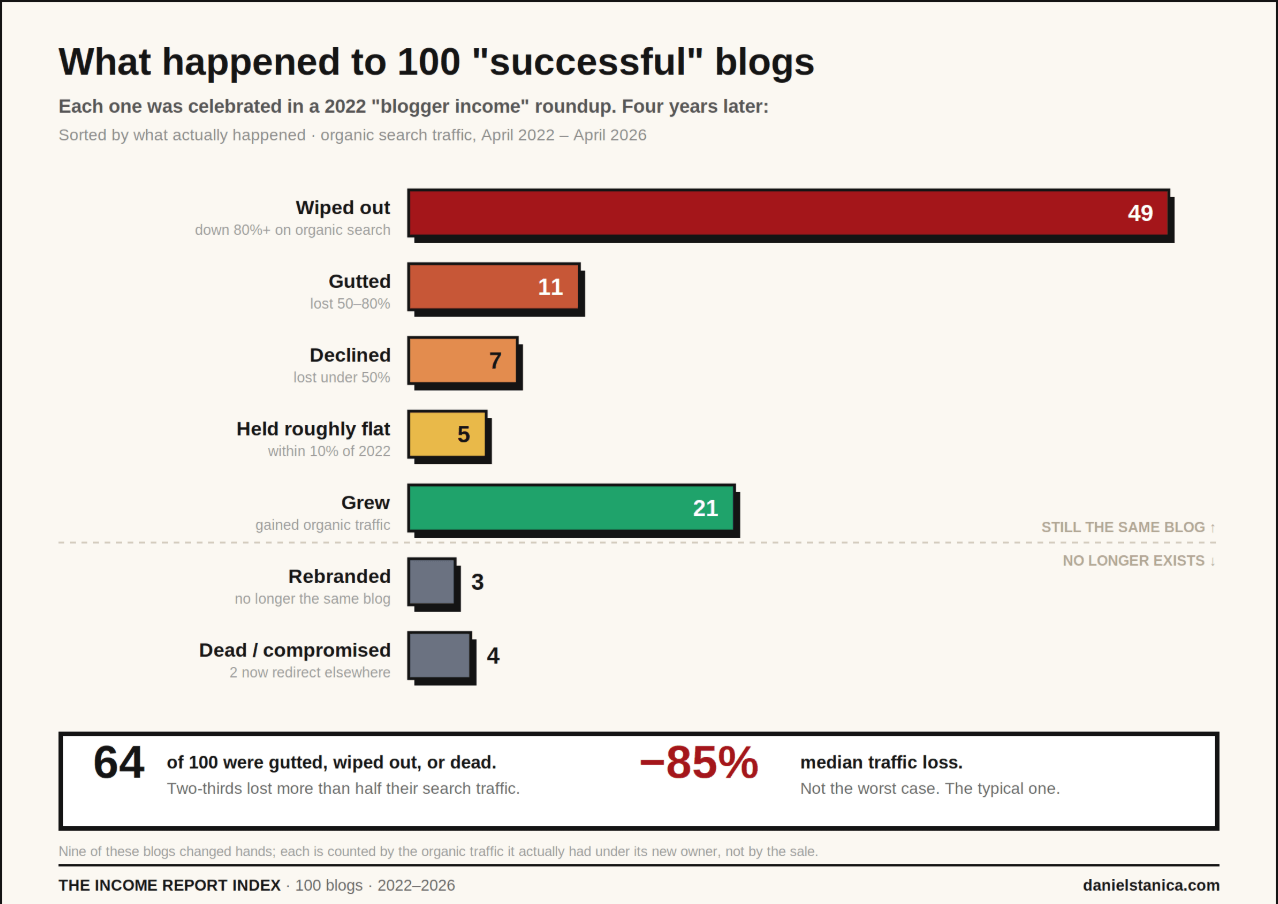
9 out of these 100 blogs changed hands along the way. I did not give "sold" its own line, because a sale is not an outcome; it is an exit. I counted each of those 9 by the traffic it actually had under its new owner, and eight of the nine were already down more than 80 percent by the time they changed hands. The buyer inherited the decline.
Stack the bottom of that list, and the arithmetic is hard to argue with: 55 of the hundred were gutted, wiped out, or dead. Two-thirds lost more than half their search traffic, and the median site lost 85 percent.
I keep returning to that median, because people hear it as a worst case, and it is the opposite. It is the typical result. Pick a blog off this list at random, check on it today, and the most likely thing you find is a site running on about one-seventh of the traffic it had four years ago. Not a tail risk. The middle of the distribution.
The extremes are worse than the median lets on. 20 blog sites lost 99 percent or more. 12 are now at zero organic visits. These were names people screenshotted and pinned to vision boards.
If we consider the raw traffic across all 100 sites, the total monthly traffic of the analyzed blogs fell from roughly 17.8 million visits to 12 million, down about a third. A third sounds survivable, like a bad year you grind through.
However, that figure is a composition trick, and the same trick is hiding in many portfolios and acquisition decks right now. Three food sites carry it: Kitchen Sanctuary, Pinch of Yum, and Jessica Gavin are so large, and two of them grew so enormously, that they hold the whole average up by themselves.
If we remove those three, and the other 97 blogs fell by 63 percent together, from about 11 million monthly visits to 4 million.
So the real story is not "the average blog is down a third." It is "two recipe empires are thriving and nearly everyone else's house burned to the foundation."
Possible reasons for this abrupt change
Google added "Experience" to its E-E-A-T quality framework in December 2022, making demonstrable firsthand experience a ranking input for the first time. The Helpful Content Update of September 2023 devastated independent publishers, and sites like HouseFresh and Retro Dodo lost 60–90% of their traffic with no meaningful recovery. Monetize.info (now MonetizeBetter.com) had the same fate.
The March 2024 core update went further; Google itself said it aimed to cut low-quality content by ~45%, and the now-famous independent review site HouseFresh lost 91% of its Google traffic in its wake. Then, AI Overviews moved from experiment to default across 2025–2026. None of that is in dispute.
Look at what these blogs were made of. Their traffic came overwhelmingly from informational queries like "how to", "what is", "best ways to", which are answered with content that was competent but rarely demonstrated genuine firsthand experience. That is the exact profile the Experience update and the Helpful Content system were built to demote. Their business depended almost entirely on a single channel: Google organic, with no meaningful owned audience to cushion a hit. And their content was, by design, summarizable — a "best budgeting tips" post is precisely what an AI Overview can synthesize and hand to the user without anyone having to click through.
Looking deeper into different niches
The collapse sorted, almost cleanly, on one variable: how much the content required the author actually to do something a machine can't fake. I call it irreplaceability, and once you see it, you can't unsee it.
Rank the niches by median outcome, and the line draws itself:
- Parenting: +108%.
- DIY/crafts: +2%.
- Food: −44%
- Travel: −74%.
- Lifestyle −90%.
- Entrepreneurship / make-money-blogging −93%
- Health −93%.
- Fashion −95%.
- Finance −99%.
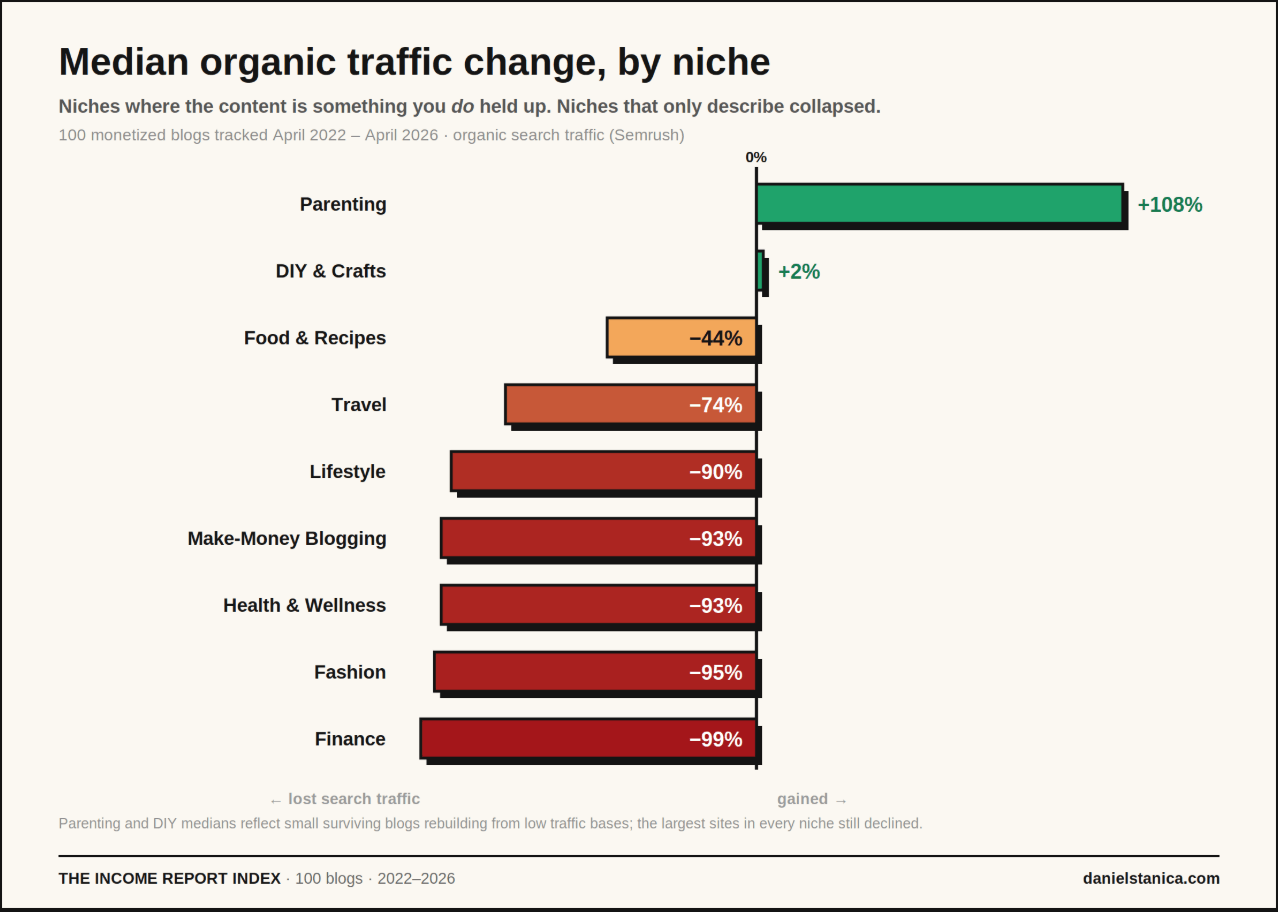
The niches that survived are the ones where the content is the doing.
The survivors cluster in firsthand, experiential, community-bound content: a recipe you actually cooked, a crochet pattern you tested stitch by stitch, a mother documenting her own pregnancy week by week with her own photos and printables.
Parenting niche
But read the top of that list carefully, because the median is doing something specific there. Parenting and DIY rank highest not because every site in them thrived because they didn't, but because the ones that survived in this cohort were small, personal blogs that rebuilt an organic base from a low starting point. At the same time, the big players in those same niches were gutted exactly like everywhere else. Easy Baby Life's organic visits fell from 54,000 to 1,100, and the Flooring Girl's fell from 29,600 to 1,200. The distribution is bimodal: in the surviving niches, firsthand content compounded, and everything else still burned to the ground.
The median indicates that the survivors were real and concentrated in experiential niches. It does not tell you the niche was safe. There was no safe niche. There was only safe content.
Food niche
Food is the cleanest proof, because it survived at scale rather than at the margins. A recipe is something you actually cooked: the photos, the timing, the "this looks too thin but keep going" firsthand proof an algorithm can't generate, and an AI can't fully replace, because the reader is standing in their kitchen trying to make the thing work.
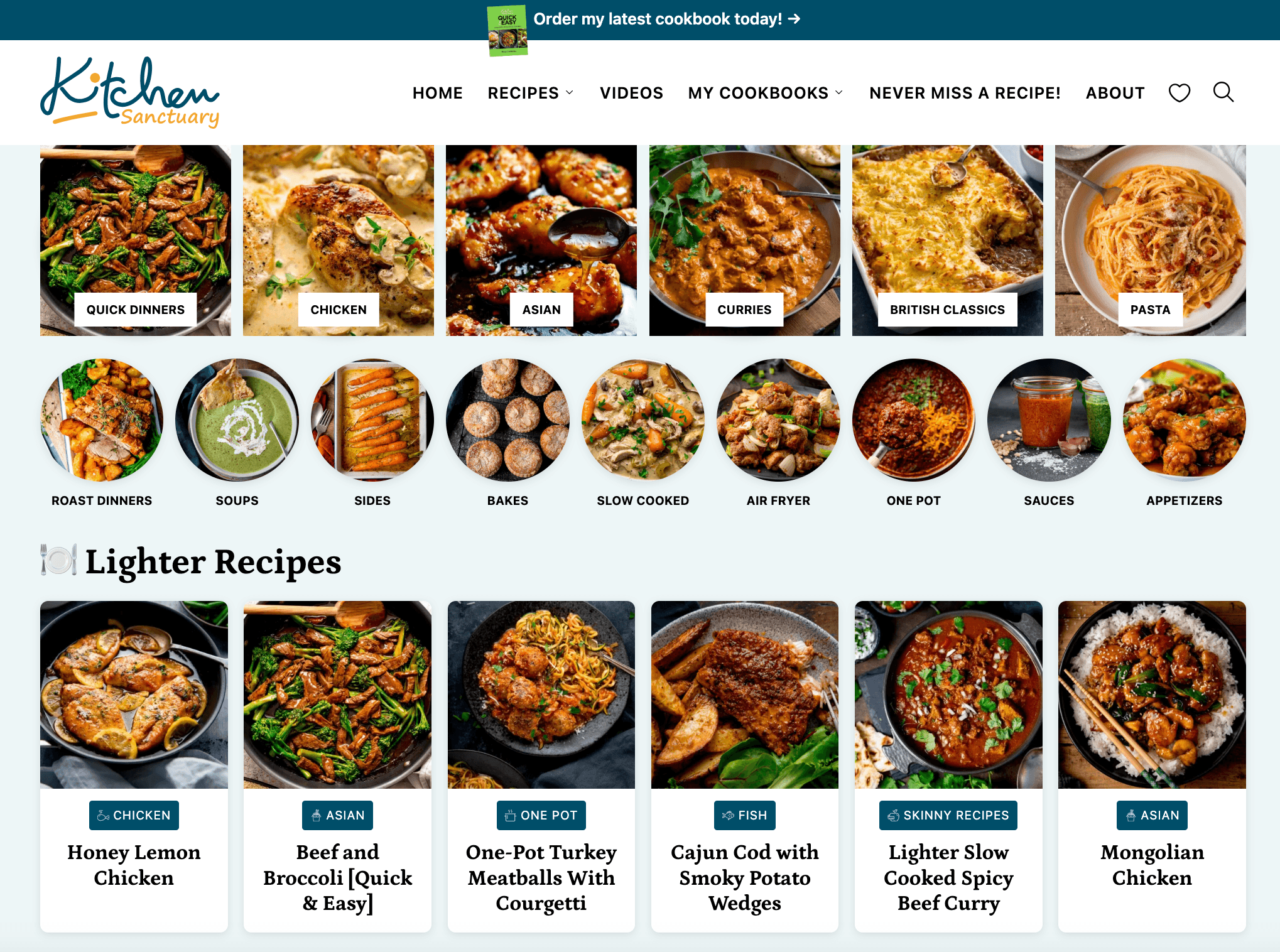
Kitchen Sanctuary didn't just survive; founder Nicky Corbishley turned it into two cookbooks with a major publisher, one of which was a Sunday Times bestseller, while the site's organic search traffic grew from 950,000 to 2.4 million monthly visits, making it an increase of 3.2 million across all channels.
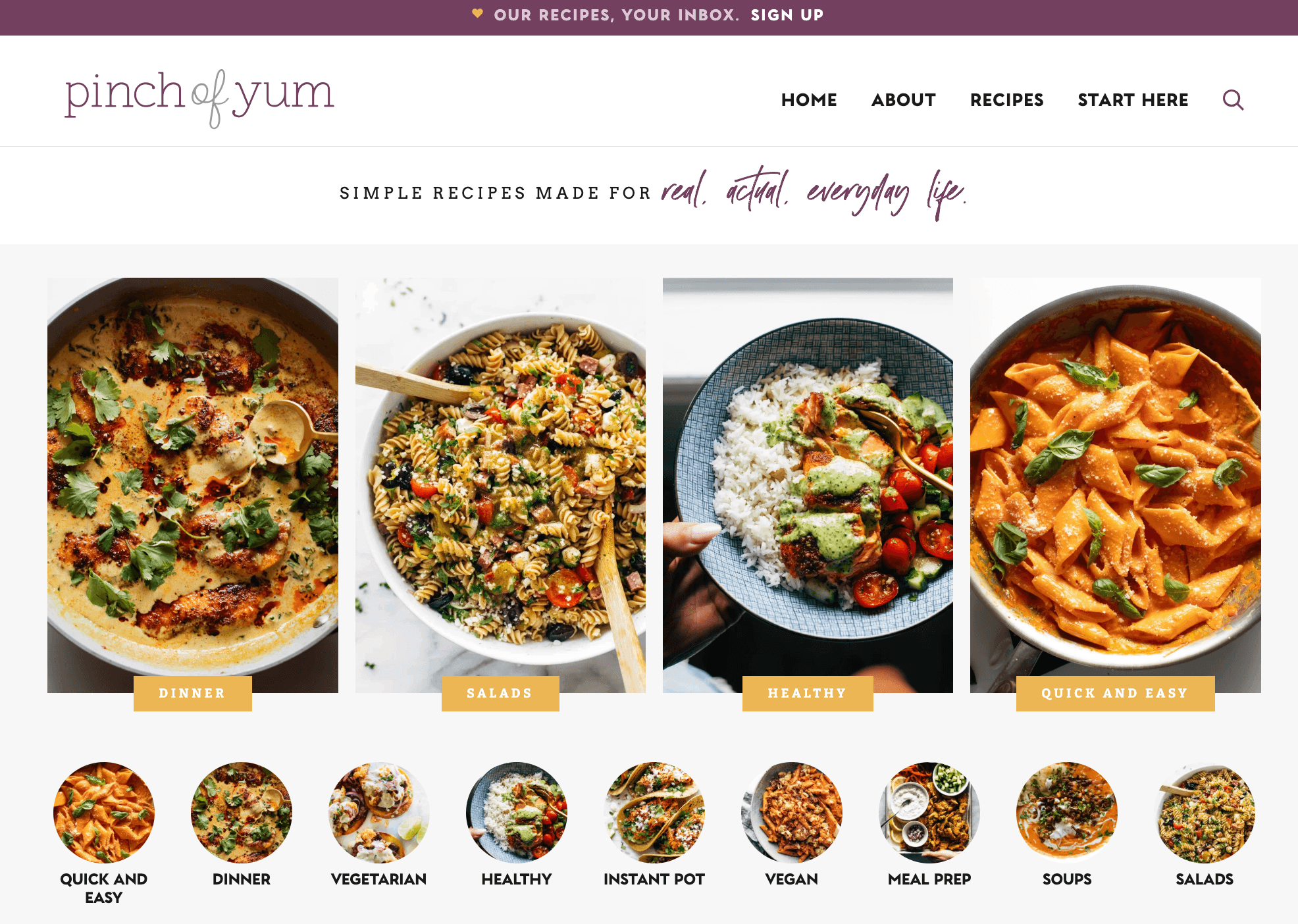
Pinch of Yum, one of the most-copied food blogs on earth, grew its organic traffic from 1.3 to 2.2 million across the exact window that flattened everyone else.
DIY & Crochet Niche
And crochet, a microscopic slice of the blog cohort, produced the standout of the entire DIY niche: Crochet365Knittoo more than quadrupled its organic search traffic, from 30,000 to 128,000, because a tested pattern, photographed step by step and followed stitch by stitch inside a community, is the purest "content is the doing" there is. When the doing is irreplaceable, it doesn't just survive, but it compounds.
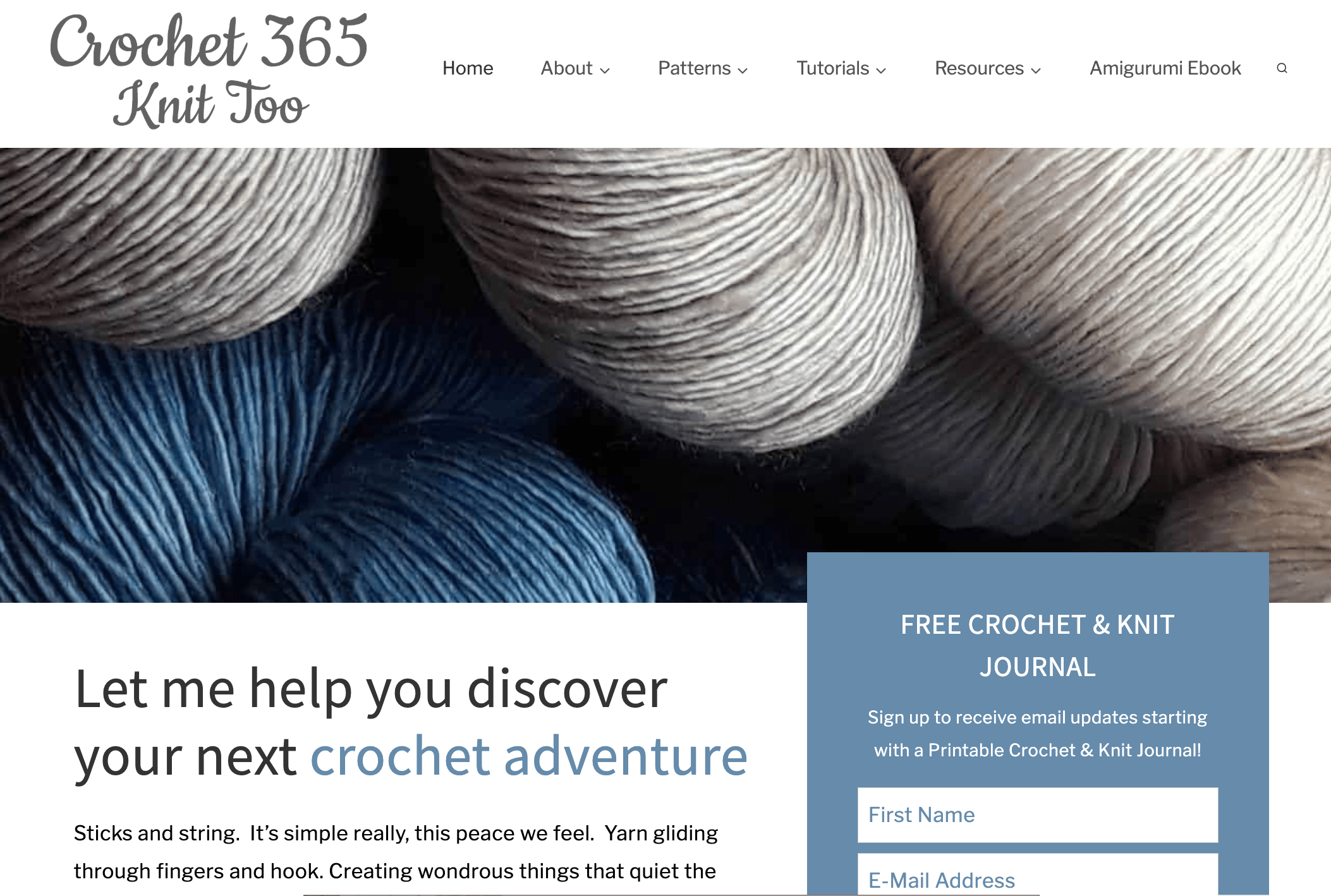
The niches that were annihilated mostly described things.
Make-money advice, generic personal finance, surface-level how-tos that consist mainly of content where the writer had no irreplaceable firsthand stake, the same information lived in a thousand other posts, and the search engine could increasingly answer the question itself. The make-money-online niche, fittingly, could not make money online. It taught a model that ate itself.
The bottom of that ladder is where the model died outright, and the pattern is the mirror image of the survivors: these are the niches that described rather than did.
Finance Niche
At a median of −99%, generic personal finance was the most summarizable category in the cohort. Searches like "how to build an emergency fund," "best budgeting apps," "what is a Gold IRA" — questions an AI Overview now answers in three sentences without a click.
This Online World went from 120,000 organic visits to 15, while Well-Kept Wallet went from 300,000 to 619, and Wealthy Nickel, The Savvy Couple, and a dozen others reached effective zero. Twenty-one finance sites, and the typical one, essentially lost everything.
Health Niche
This niche was nearly as total, at −93%. A blog explaining a condition, a symptom, or a supplement is offering exactly the kind of consensus information that Google now answers directly.
About Social Anxiety fell from 21,100 organic visits to 1,400; Imperfect Idealist, from 34,000 to 2,000. There is no firsthand moat in summarizing what's already a medical consensus, and the answer engine took it wholesale.
Fashion Niche
Fashion niche finished at roughly −95%. Style and outfit content looks experiential, but most of it is descriptive and infinitely substitutable: one "spring capsule wardrobe" post is interchangeable with ten thousand others, and Pinterest and AI image results have absorbed the discovery traffic that used to land on blogs.
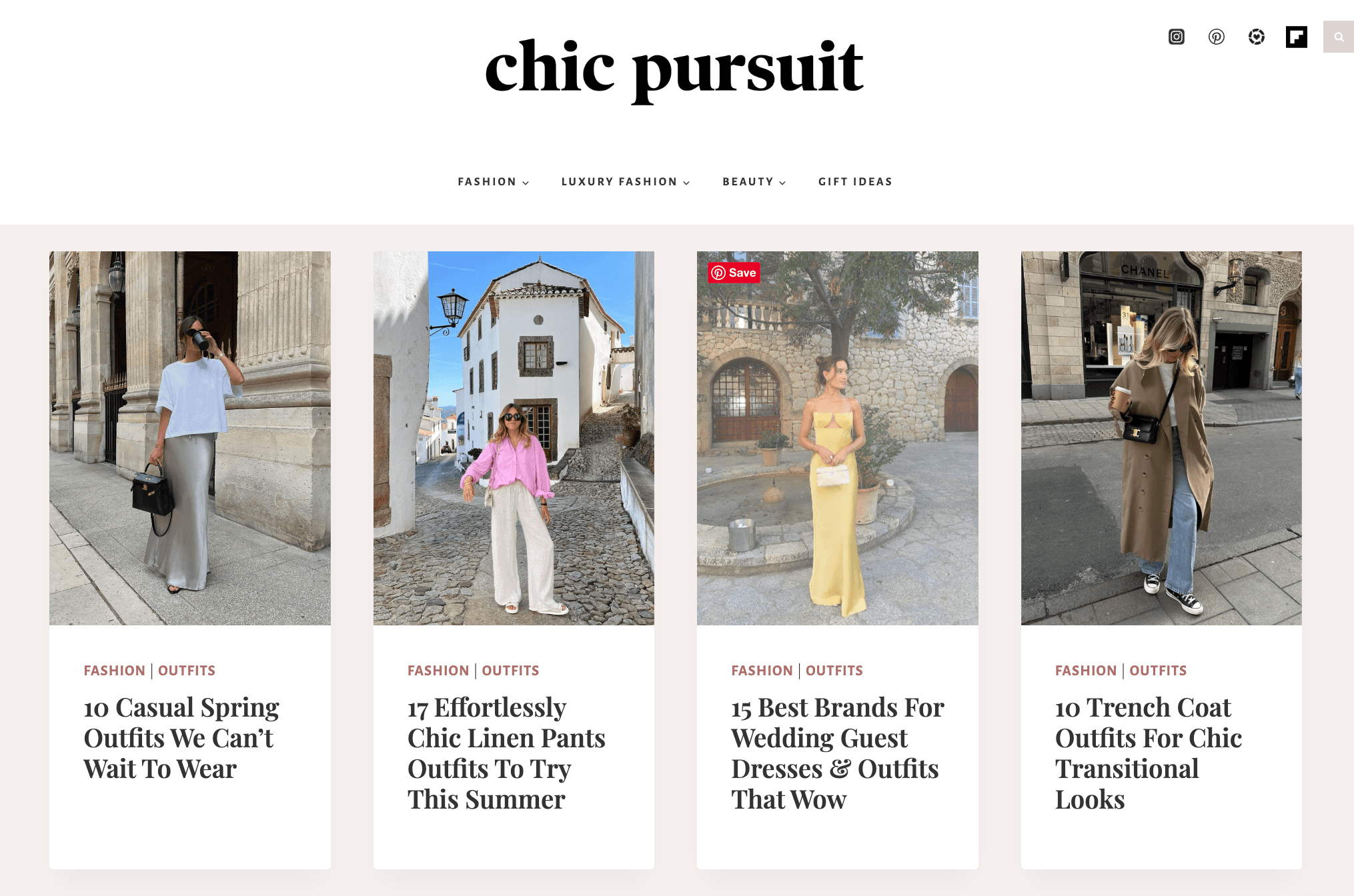
Chic Pursuit collapsed from 88,500 organic visits to just 4,000; Fit Mommy in Heels, from 61,300 to literally zero.
What the survivors had, and these niches lacked, is the same thing every time: a reason the reader needed this author, doing something the answer engine couldn't reproduce. Finance, health, and fashion mostly didn't have it, and the data shows precisely what happens when you don't.
Travel Niche
The blogs in the travel niche prove the rule by breaking it in part. That’s because the travel content is experiential, on places you genuinely went, but it's also highly summarizable: "top 10 things to do in Dubai" is exactly what an AI Overview assembles. So travel split. Operators who niched into specific, hard-won regional expertise held or grew.
Living The Dream grew while continuing to publish transparent income reports, announcing that in May 2026, he earned $8,500 from his blog. (CPM Ads: $3,500, Sponsored Ads: $2,545, Affiliates: $2,000)

The bloggers who were publishing interchangeable destination listicles got hollowed out. Experience alone wasn't the moat. The moat was experiencing the result that couldn't be produced without it.
That distinction is the whole game now, and it's the same test that decides who survives AI.
The second extinction is already happening.
The Helpful Content era punished content that served search engines over people. The AI Overview era doesn't bother punishing the content; it just answers the query before the user clicks. As of early 2026, roughly half of Google searches show an AI Overview, and Ahrefs has measured that its presence cuts clicks to the top organic result by about 58%.
Zero-click searches, where the user gets the answer and never leaves Google, now account for the majority of searches by most measures. Product-comparison and informational queries, the exact territory most of this cohort occupied, sit in the highest AI-Overview-density categories of all.
And the traffic that does flow through AI doesn't flow where the old model assumes it would. A Semrush analysis of LLM citations found Reddit was the single most-cited domain at around 40%, with Wikipedia at 26%, community sentiment, and reference material, not affiliate-laden review posts.
A separate 30-million-source study found that Reddit, YouTube, and LinkedIn led in citations across every major AI platform. Most damning for the old playbook: only about 38% of AI citations now come from top-10 organic results, down from 76% in mid-2025.
Ranking number one no longer even guarantees you're the source the AI quotes. A budgeting question that once sent a click to a personal-finance blog now gets answered from a synthesized summary that might cite a Reddit thread — if it cites anyone at all.
So the same content that failed the first extinction is failing the second, for the same root reason: it's summarizable, has no firsthand moat, and lives entirely on a channel its owner didn't control. The blogs that survived the first wave because their content couldn't be replaced are, not coincidentally, the ones best positioned for the second. The thing that protected you from the algorithm is the same thing that protects you from the answer engine. There was only ever one moat, and most of this cohort never had it.
One more warning the AI data carries, for anyone planning to "win AI citations" as the next gold rush: that traffic is even less ownable than search. Semrush documented Reddit's share of ChatGPT citations collapsing from roughly 60% to 10% in about six weeks on a single retrieval change by OpenAI.
AI visibility isn't a successor to the #1 ranking. It's a portfolio position across surfaces you don't control, re-decided continuously by model providers. Build a business on it as your sole channel, and you've learned nothing from the hundred blogs above.
What kind of blogs survived
What actually survives is content that demonstrates firsthand experience a machine can't produce or summarize from other sources, distributed to an audience you own, ideally tied to a real product and a real brand name people search for.
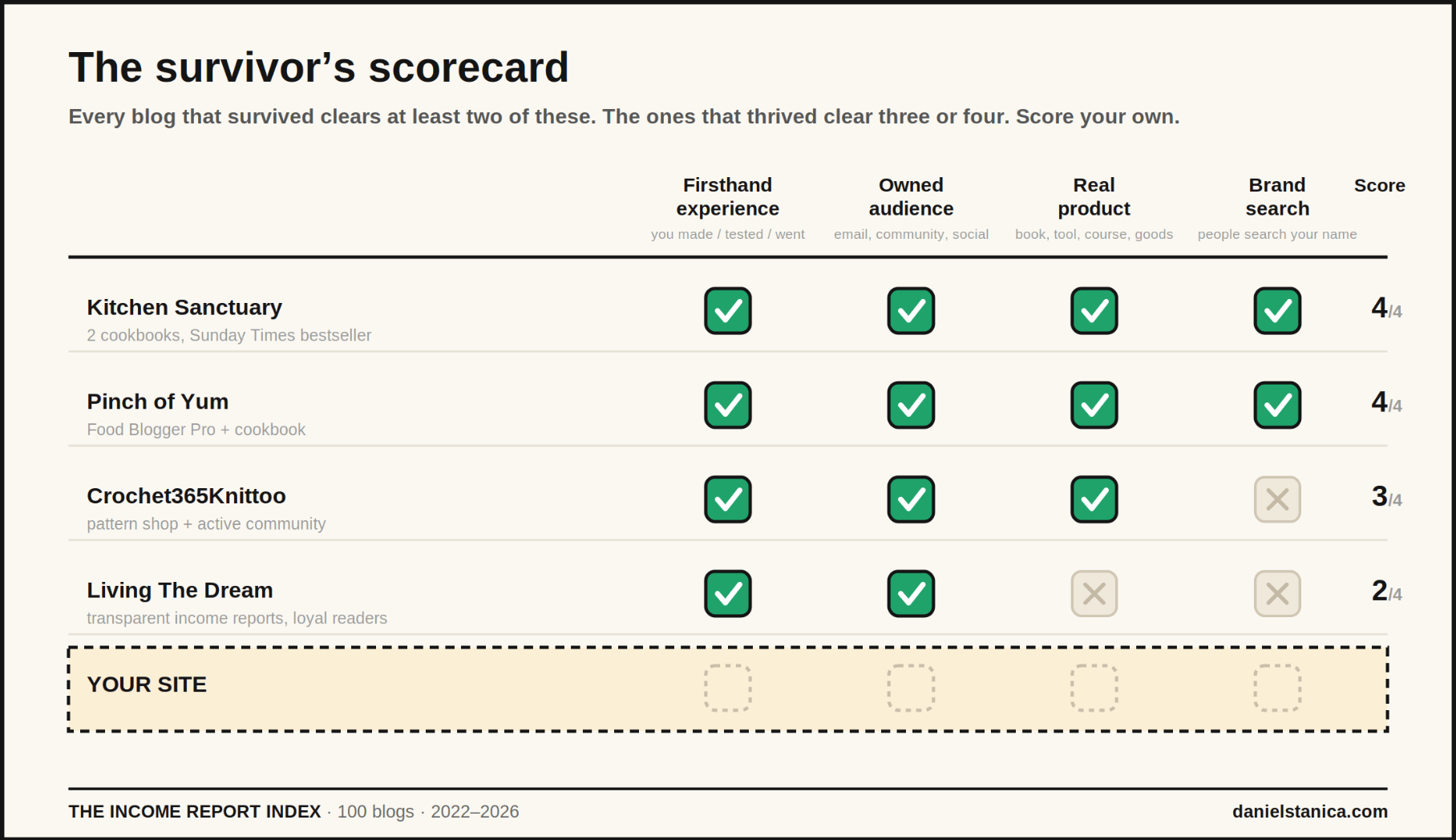
Every survivor in the dataset has at least two of those four traits. The thrivers have three or four. So here is what to do about it.
If you're considering starting a blog today.
Build only where value can't be delivered to a reader via an AI summary without them needing you. That means demonstration over description: things you make, cook, test, build, or go to, documented with proof you actually did them.
Pick a niche where you have genuine firsthand experience or a credential, because Google's Experience signal and AI citation engines now reward exactly that.
Also, assume from day one that search is a customer-acquisition channel, not a business, and that the business is the email list, the community, social media, or the product you convert that traffic into.
If your plan doesn't include an owned audience by month six, you're building a website that will be very difficult to monetize and grow.
If you're holding a declining blog right now.
Triage it honestly against four options, in this order.
- Consolidate - Cut the thin, summarizable informational pages that no longer rank, and pour everything into the handful that demonstrate real experience. A focused 30-page site of genuine firsthand content beats a 500-page content farm on every signal that matters now.
- Convert - Whatever search traffic you have left is a melting asset, so spend it immediately to build an audience you own: email newsletter, a community, a WhatsApp/Telegram channel. Rented audiences on Social Media, like a YouTube channel and Fb group, can also work, with the caveat that when their algorithms change, you may face the same reach problem as you do now with Google search. Joe Youngblood wrote a guide about building an owned audience.
- Productize - If the audience trusts you, turn that trust into a product like a book, a tool, a physical or digital good, because the product-business archetype was the second most durable in this entire study and monetizes a relationship instead of a pageview.
- Sell - If none of the above is realistic for your asset, sell it while the traffic chart still shows something, because the next two updates won't be kinder than the last four.
If you're sitting on real brand equity.
The independent sites that died had little to no brand search, meaning nobody typed their name into Google, whereas the survivors increasingly did.
If people search for you, you have something the algorithm and AI both treat as a trust signal, and almost nobody is deliberately building it. Put your name, your face, and your firsthand authority everywhere the citation engines look: structured first-party data and original benchmarks on your own site, video on YouTube (which now carries an outsized AI-citation and AI-Overview advantage), and genuine participation in the communities where AI gets content from. Treat it as a portfolio across surfaces, because any single one can be re-weighted overnight.
What to stop doing.
Stop publishing summarizable how-to content with no firsthand stake, as this category is the most exposed to both Google and AI, and it's most of what this cohort published.
Be deeply skeptical of the two pivots the market is loudly selling: course-and-coaching funnels and "bolt an AI tool onto your blog." They were the two worst-performing archetypes in this study, with the lowest median traffic and almost no growth. They're lifeboats people climb into after the ship is already going down. They are not a way to keep the ship afloat.
FAQ regarding Blog as a Business Model
Are blogs dead in 2026?
The blog-as-a-business model is dead; blogging is not. This study shows that the model's biggest winners, two-thirds, lost the majority of their search traffic, and the median site lost 85 percent. The ones that grew shared a single trait: content, backed by firsthand proof that an AI answer cannot reproduce.
Do blogs still make money in 2026?
Some do, but far fewer than the income-report era implied. Of 100 once-successful blogs tracked from 2022 to 2026, only 21 grew their organic traffic, and the durable earners shared a pattern: experiential content, an owned audience such as email or community, and a real product. Blogs monetizing pure search traffic with ads and affiliate links were hit hardest.
What happened to blogs after Google's Helpful Content Update?
Google's September 2023 Helpful Content Update and the March 2024 core update devastated publishers that relied on summarizable, search-only content. In this sample of 100 blogs, 55 lost 80 percent or more of their organic traffic, and 12 fell to zero. Sites that showed genuine firsthand experience and real brand recognition were far more likely to survive.
How do AI Overviews affect blog traffic?
AI Overviews answer the query before the user clicks. By early 2026, they appear on a large share of searches, and Ahrefs measured roughly a 58 percent drop in clicks to the top organic result when one is present. Informational and comparison content, the staple of most monetized blogs, sits in the highest AI-Overview-density categories and loses the most.
Can a blog recover from a Google core update?
Recovery is rare for content that was always summarizable. Across 100 tracked blogs, sites hit by the Helpful Content Update showed little meaningful recovery years later. The blogs that came back, or never fell, were the ones demonstrating firsthand experience, cooking, building, testing, and traveling- things that an algorithm cannot fake and an AI cannot fully reproduce.
What kind of blogs will still grow in 2026?
If your main source of traffic is Google search, you should consider blogs that cover experiences that cannot be AI-summarized. In this study, food recipes, parenting advice, and crochet led the way, because a tested recipe or a photographed stitch-by-stitch pattern is firsthand proof that a reader is actively following along. Do not rely on generic finance, health, or fashion advice. The dividing line was irreplaceability: whether the reader needed that specific author to get the result.
Conclusions
A content site's traffic history is now a risk model. A site whose traffic is entirely organic, in a summarizable informational niche, with no owned audience and no brand search, is a melting ice cube, no matter how good last year's numbers look. This dataset is full of them, many sold to buyers who read the trailing revenue and ignored the trailing traffic.
The blog-as-a-business model, involving publishing, ranking, monetizing clicks, and repeating the cycle, is dead. Not dying but dead. The data on all 100 of its supposed best cases says so plainly. What replaced it is content nobody else can credibly make, distributed to an audience you own, under a name people actually search for.
Changelog:
27.06.2026 - I’ve added an explanation making a clear distinction between owned and rented audience, and added Joe Youngblood’s guide on how to grow an owned audience.


9 Comments