CMS Conf 2026 Recap: Three Days in Gdynia
I spoke at CMS Conf 2026, held on November 12-14 in Gdynia, Poland. This is a different kind of event from the domain, hosting, and affiliate conferences I usually cover on this blog. It puts the CMS itself on the main stage, and it does it across platforms instead of inside a single community.
Read on to see what happened in the first edition, then grab your ticket for 2027 for only 50 euros during the early-bird promotion, if you build, run, or sell on top of a CMS.
TLDR: CMS Conf 2026
CMS Conf is a vendor-neutral conference for developers, creators, and companies working with content management systems: WordPress, Joomla, TYPO3, EmDash, and the rest.
The first edition took place on November 12-14, 2026, at the Pomeranian Science and Technology Park (PPNT) in Gdynia, Poland, with three parallel tracks: developer, creator, and local.
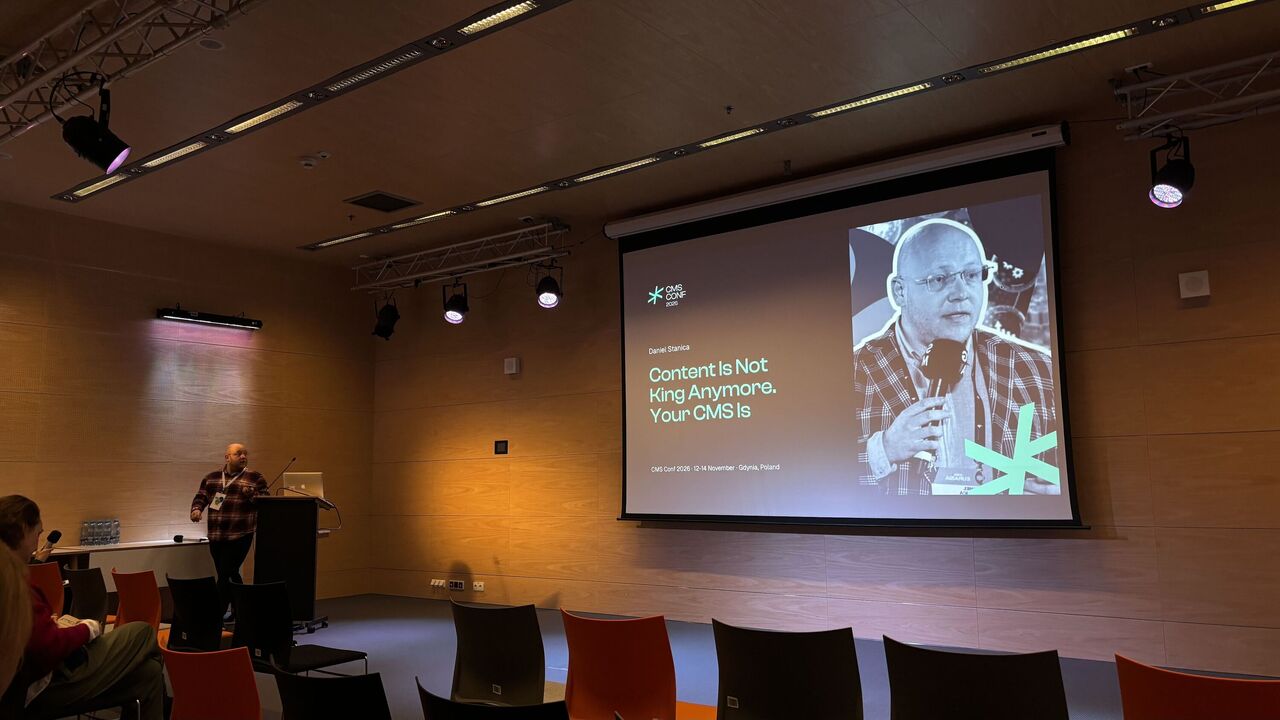
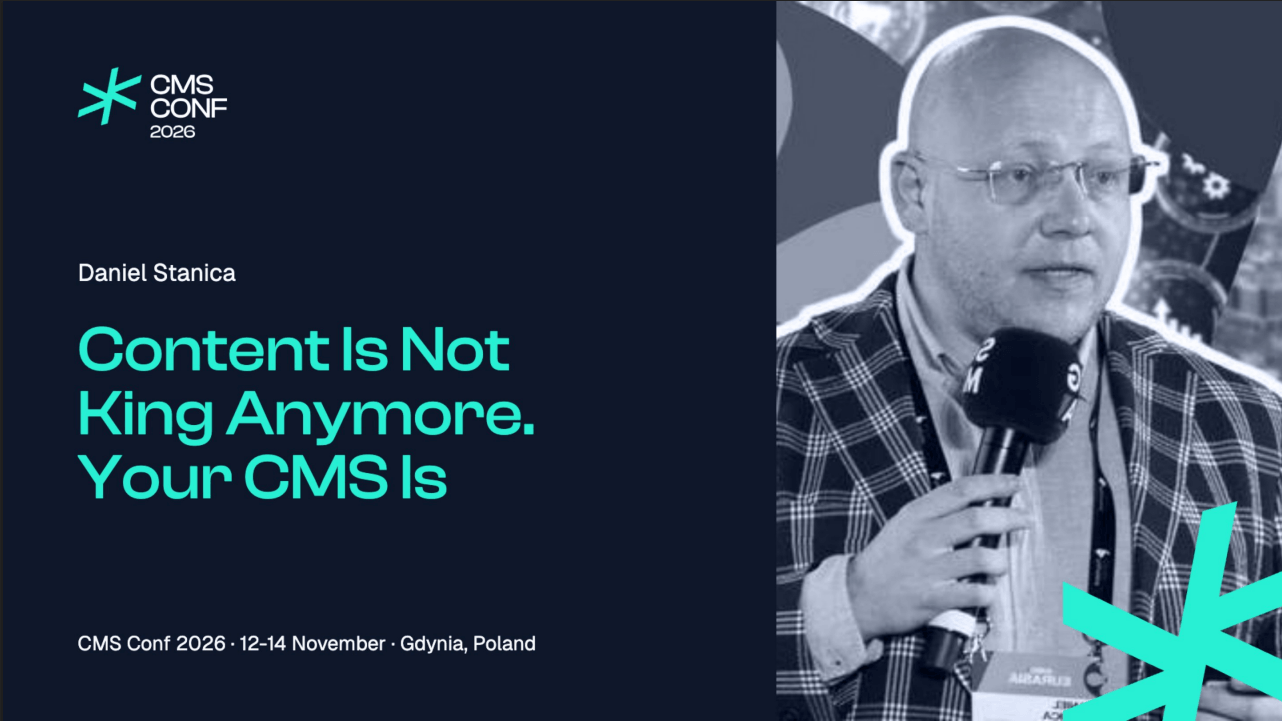
I presented "Content Is Not King Anymore. Your CMS Is.", a session on why the CMS now decides whether AI can see a business at all.
What is CMS Conf?
Most web conferences treat the CMS as a side topic: one session here, one workshop there, squeezed between framework talks. CMS Conf starts from the opposite idea: that content systems are the main event.
It is also deliberately cross-platform. Instead of another event where one community talks to itself, WordPress people sat next to Joomla, TYPO3, and EmDash people and compared how each system solves the same problems.
After 20 years inside the WordPress bubble, that alone was worth the trip.
The organizers ran three parallel tracks over the three days:
- Developer track: architecture, security, migrations, and AI-assisted development
- Creator track: content, SEO, accessibility, and workflows
- Local track: sessions for the Polish community
In addition to the talks, there were hands-on workshops where you could build alongside the people who make the tools.
CMS Conf 2026 Recap
I just got back from Gdynia. It was the first edition of CMS Conf, but it ran like an event that had been around for years. The speakers were experienced practitioners, and you could tell from how much practical advice they shared instead of theory.
With three tracks running in parallel, I could only attend part of the program. Here is what stayed with me.
10 takeaways from CMS Conf 2026
1. AI does the work, humans make the decision. Jovana Smoljanovic Tucakov [LinkedIn] from Melograno Venture Studio showed the framework she uses daily to work side by side with AI on content and SEO: AI handles research and execution, while strategy and approvals stay human. Michał Szymoszek [LinkedIn] reached the same conclusion from the developer side, after walking us through AI-assisted projects and what worked and what didn't.
2. Vibe-coded apps get hacked. Lana Rafaela [LinkedIn] from Patchstack shared how apps built by prompting get compromised, and what we can do to monitor and prevent it. The same theme came up at Atlas Digital Summit in September, so this is clearly not going away.
3. Session hijacking deserves more attention. Robert Abela [LinkedIn] from Melapress gave an insightful presentation on WordPress security, focused on session hijacking and how to prevent and limit these attacks.
4. A migration that looks great to developers can fail editors. Maciek Palmowski [LinkedIn] from Patchstack showed what can happen during a CMS migration, and why the result may look perfect to the dev team but very different to the people who publish in it every day.
5. Joomla can do more in Core than you think. Elisa Sophia Foltyn [LinkedIn] presented Joomla's capabilities and how features like SEO and content translation ship in the core, with no plugins needed. Mathias Bolt Lesniak [LinkedIn] did the same for TYPO3. Coming from WordPress, where the answer to everything is a plugin, this was a useful reality check.
6. A whole CMS can run in the browser. Fellyph Rozendo Cintra [LinkedIn] introduced WP Playground and how you can run an entire CMS, or even a game, in the browser through WebAssembly.
7. EmDash is built for the AI era. Matt Kane [LinkedIn] from Cloudflare presented EmDash and what it can do, and Noah Pham [LinkedIn] ran a workshop where we worked side by side with AI to deploy, extend, and ship. You probably know by now that I'm hooked: this site runs on EmDash.
8. Accessibility is a moat. Anne-Mieke Bovelett [LinkedIn] gave practical advice on accessibility and how developers and companies can use it as an advantage when selling to enterprises.
9. Workflows and assets are where the time goes. Dominik Liss [LinkedIn] presented a framework for agencies to optimize their workflows and save time and resources. Paweł Zmysłowski [LinkedIn] brought the enterprise view: companies pile up digital assets like webinars and presentations, and the CMS sits at the core of putting them to work.
10. Support and open source are the long game. Raitis Sevelis [LinkedIn] from WPBakery shared what he learned from onboarding 6M users and how much support matters. His view that product companies should help clients beyond the product itself, if they want better retention, is one I keep coming back to. Marcel Bootsman [LinkedIn] from Kinsta made the case for why companies should sponsor the open source projects they depend on.
The team behind CMS Conf
CMS Conf is organized by a team of CMS professionals and community contributors, not by a vendor. That shows in the program: no platform got special treatment, and no talk felt like a sales pitch.
One of the co-organizers is Jakub Czechowski, who builds websites and e-commerce at JC Web Studio, runs StackCompass, a publication on content architecture, and also co-organizes WordCamp. Mariusz Szatkowski announced the event on the conference blog.
The team also runs the CMS Conf Podcast, which kept the conversation going for months before the event. You can check out the episode where I talk about the importance of personal websites for AI Visibility here. Pulling off three parallel tracks in a first edition is no small feat, and they outdid themselves.
Why Gdynia, Poland?
Gdynia is a modern seaside city on the Baltic coast, part of the Tricity area together with Gdańsk and Sopot. I dont think it was a random choice:
- Gdańsk Lech Wałęsa Airport is about 20 minutes away, and I arrived very easily by train
- Hotels and food cost less than in the big conference capitals
- The region has a strong CMS and open-source scene, with the teams behind CKEditor, Saleor, and Sylius nearby
Mid-November on the Baltic means short days, wind, and cold, so pack accordingly. The upside is that everyone stays inside and talks to each other.
Location: PPNT Gdynia
The event took place at the Pomeranian Science and Technology Park (Pomorski Park Naukowo-Technologiczny), Al. Zwycięstwa 96/98, Gdynia. It has modern conference halls plus breakout spaces, which made running three tracks at the same time feel easy.
My session: Content Is Not King Anymore. Your CMS Is.
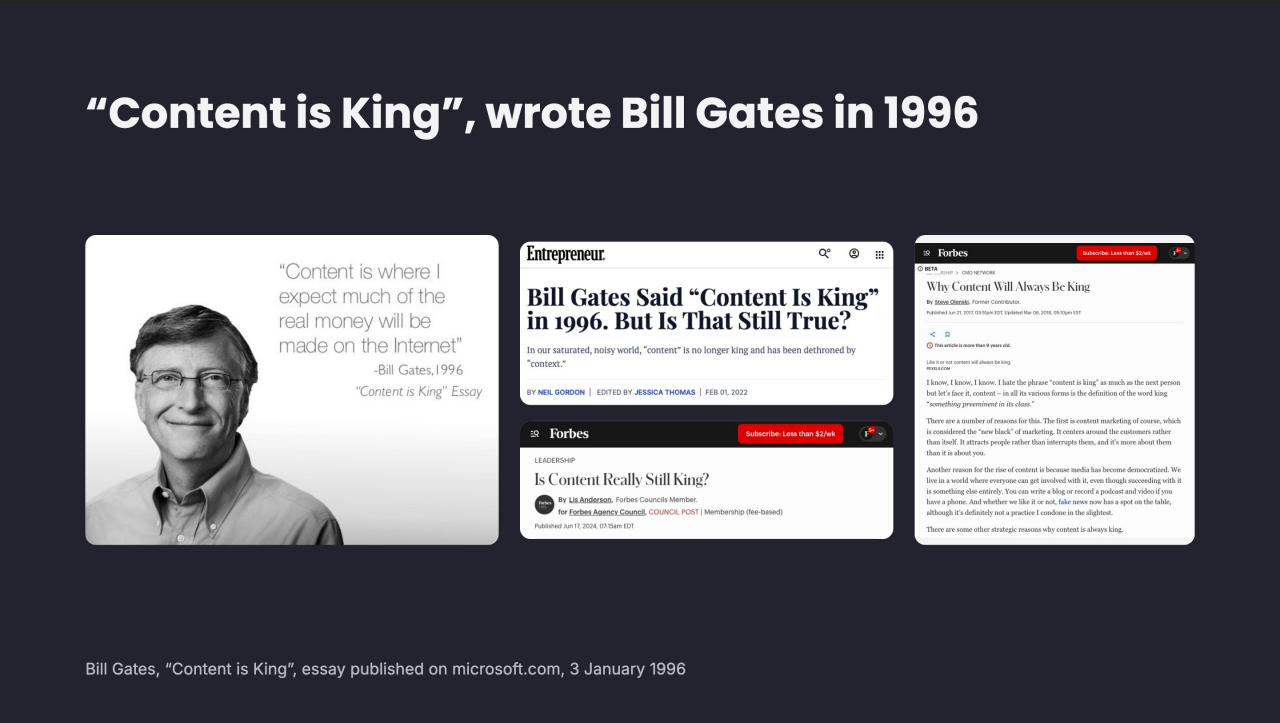
I chose this deliberately provocative title. Thirty years ago, Bill Gates wrote the essay that gave us "Content is King".
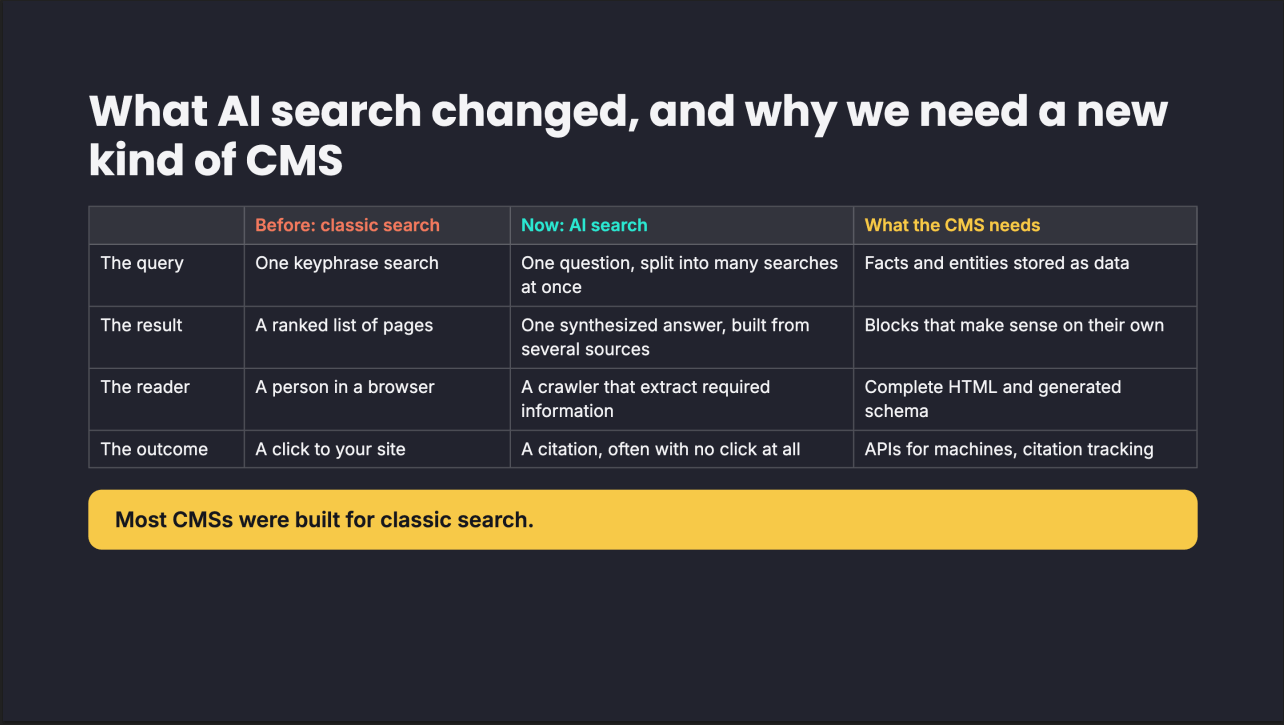
Content still matters, but as it becomes a commodity, the platform you publish on matters more than ever. Not because of design or UX, but because of how AI search systems retrieve, evaluate, and cite content. Your CMS is now part of the AI pipeline, whether you've optimized for it or not.
Here's what I covered:
- How AI search systems actually work: how ChatGPT, Perplexity, and Google AI Overviews retrieve and cite content, and exactly where your CMS sits in that pipeline
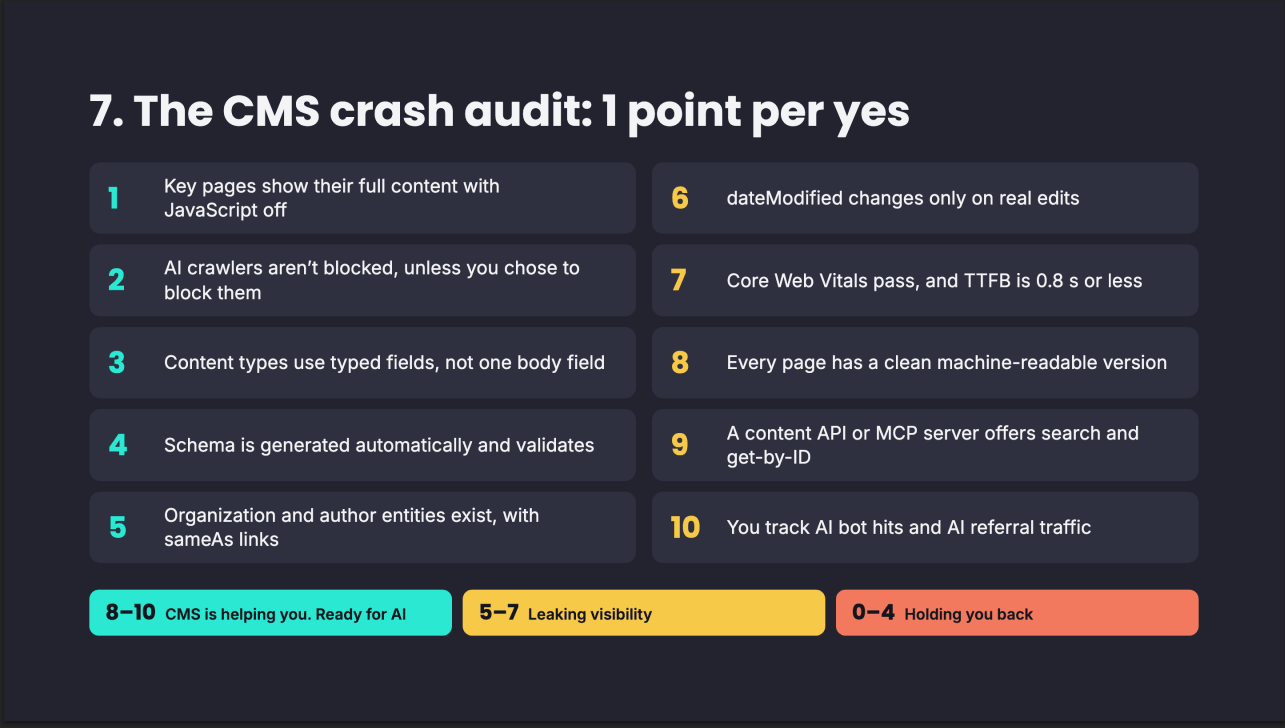
- The four silent CMS killers: missing schema, poor content structure, low speed, and no AI agent integration, plus how to diagnose each one in your own stack
- What actually determines AI citation: the schema patterns, content modeling rules, and API integrations that make the difference between being cited and being invisible
- A crash CMS audit you can run on the spot: a practical framework to get a clear verdict on whether your stack is helping or hurting your AI visibility.
Most CMS decisions are still made on editorial and developer experience criteria. Almost no one accounts for LLM discoverability. I went to Gdynia to make that gap uncomfortable to ignore, and judging by the questions and the hallway conversations afterward, it landed.
This is the same AI Visibility work I do through Competico, brought to the people who actually build and choose the systems.
The slide deck is available here.
Speakers and sponsors
This wasn't a conference with two famous keynote speakers and filler in between. The speakers I saw all work hands-on with the systems they talked about:
- Security: Lana Rafaela and Maciek Palmowski (Patchstack), Robert Abela (Melapress)
- Platforms: Matt Kane and Noah Pham (Cloudflare, EmDash), Elisa Sophia Foltyn (Joomla), Mathias Bolt Lesniak (TYPO3), Fellyph Rozendo Cintra (WP Playground)
- AI and workflows: Jovana Smoljanovic Tucakov (Melograno Venture Studio), Michał Szymoszek, Dominik Liss, Paweł Zmysłowski
- Business and community: Raitis Sevelis (WPBakery), Marcel Bootsman (Kinsta), Anne-Mieke Bovelett
I couldn't attend many more sessions across the three tracks.
The event was supported by Kinsta®, Patchstack, LH.pl, altumhost, dhosting.pl, Osom Studio - WordPress and WooCommerce Agency, Widgetizerr, and ambiscale, as none of this happens without them.
Who should attend
CMS Conf is for developers, architects, agency owners, content creators, and product companies working with any CMS: traditional, headless, or hybrid. If your whole event calendar is built around one platform, this is where you'll see what everyone else is doing.
Keep in mind that this isn't a marketing conference. The talks are practical and often technical, even on the creator track, which I loved.
CMS Conf 2027
The second edition is already announced: September 23-25, 2027, back at PPNT Gdynia. Blind Bird tickets are on sale at €50 excl. VAT (regular price €150 + VAT) before the lineup is announced.
Stay updated:
- Website: cmsconf.com
- LinkedIn: cmsconf
- Instagram: cmsconf
- YouTube: @CMSConfcom
- CMS Conf Podcast on Spotify and Apple Podcasts
Conclusion
CMS Conf is a narrower, more deliberate event than the conferences I usually cover here, and that's exactly the point. Three days, three tracks, and a room full of people who build content systems instead of just using them.
For a first edition, it was very well organized. The talks were practical, the hallway conversations were even better, and I left with more ideas than I arrived with, so big thanks to the organizers, sponsors, speakers, and attendees.