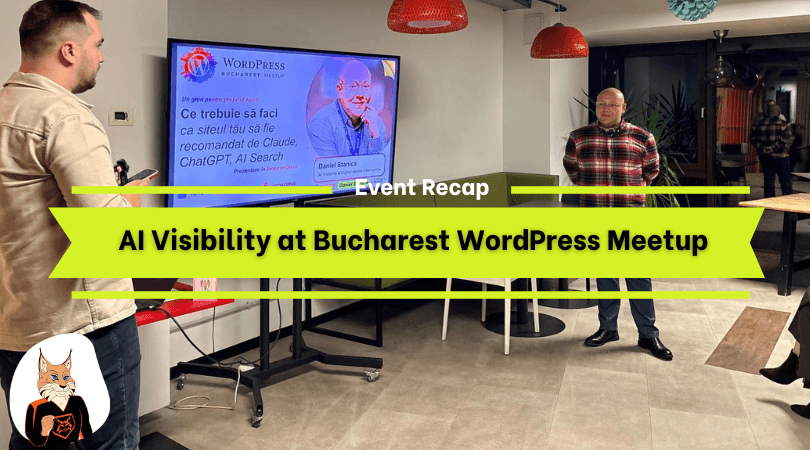
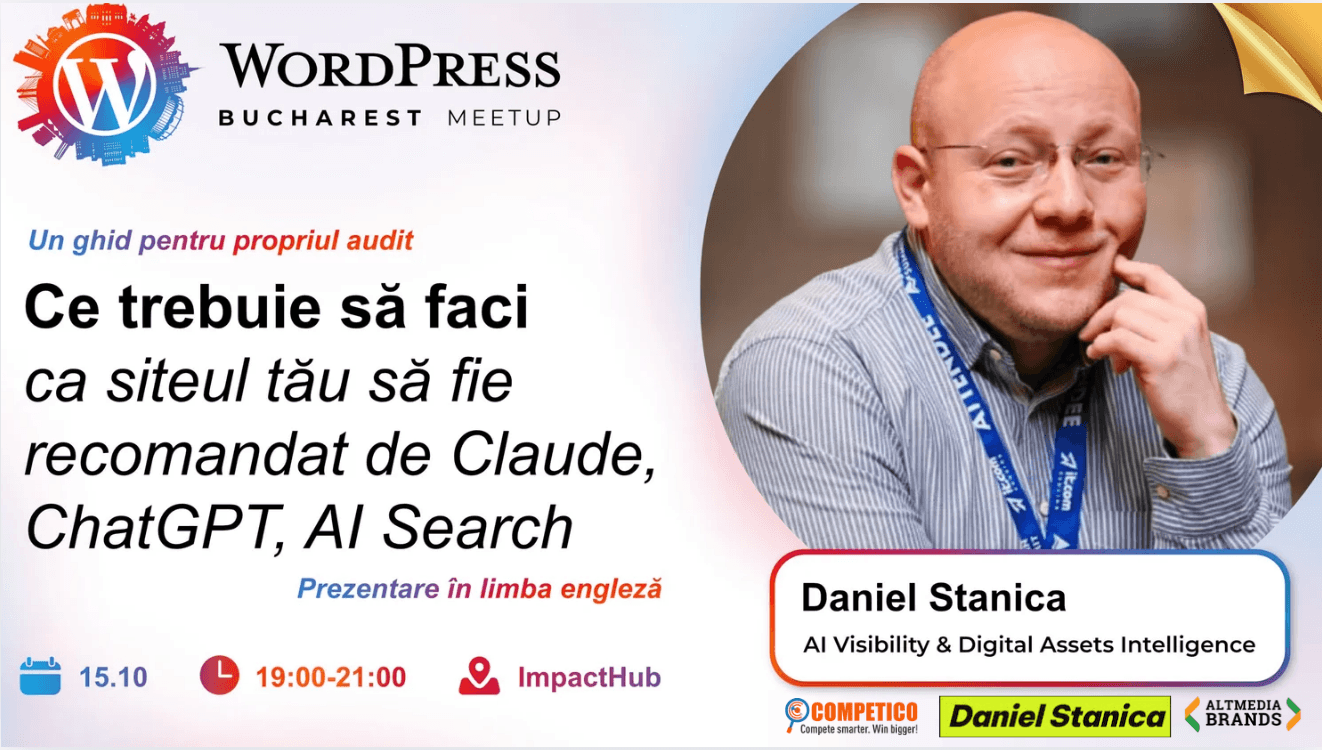
On October 15, 2026, I spoke at the Bucharest WordPress Meetup at ImpactHub about one question: when people ask Claude, ChatGPT, or Google's AI Mode for a recommendation, is your brand mentioned, cited, and recommended?
About 50 people came: WordPress site owners, bloggers, freelancers, agency people, and developers. They asked a lot of sharp, practical questions, which told me this topic has moved from "interesting trend" to "real problem on my sites or my clients’ sites"
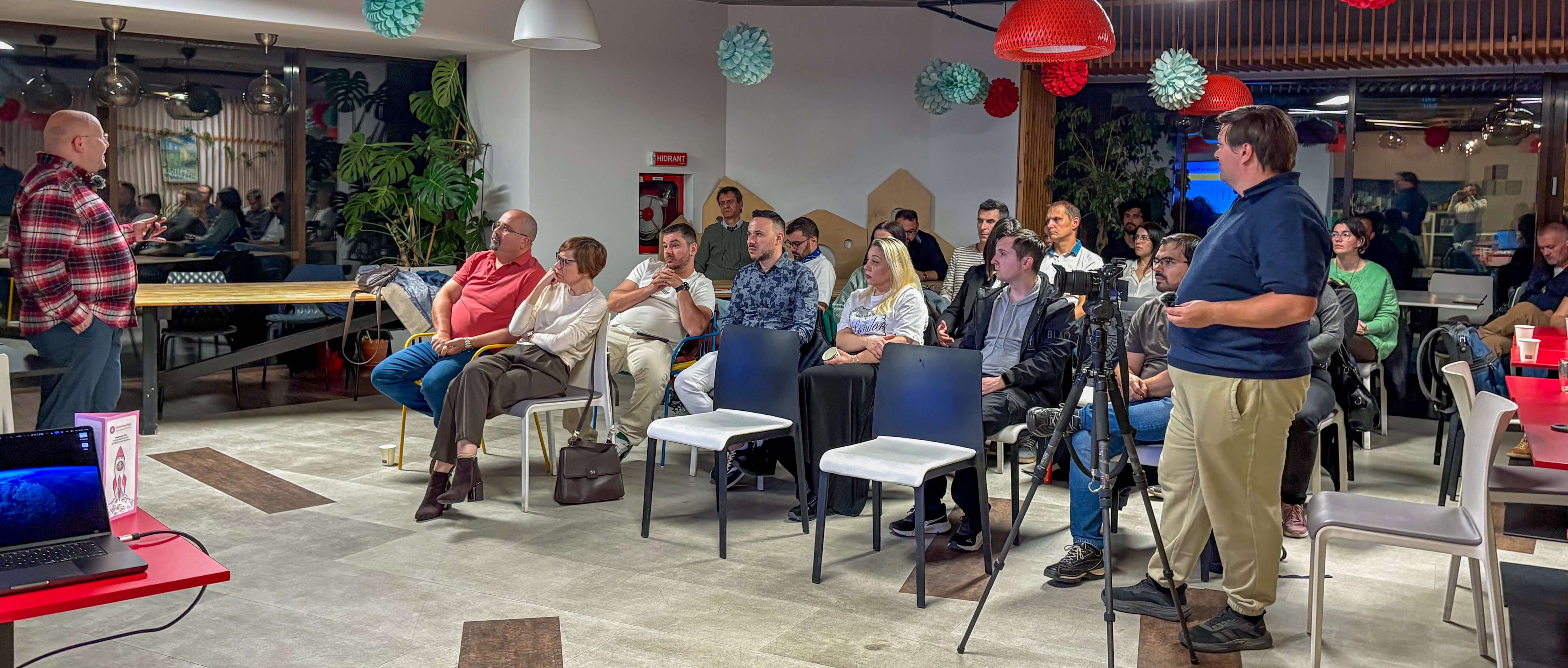
This recap covers the talk's main ideas, the WordPress checklist, and the self-audit I promised everyone. If you missed the evening, you can catch up here. If you were there, you have everything in one place.
Thank you to Lumi Ciobanu [LinkedIn], Eduard Doloc [LinkedIn], and Alex Spataru [LinkedIn] for organizing, to ImpactHub for hosting, and to Uprise.ro for sponsoring. I also want to thank everyone who attended in person and asked questions. To that end, I chose a format where audience members could ask questions after each chapter, making the information more digestible and letting people clear their doubts instead of waiting until the Q&A session.
Why AI Visibility matters now
I opened with data from my own research, the Great Blogging Collapse study, where I tracked 100 content sites across 8 niches from 2022 to 2026.
The results were shocking:
- 64% of those blogs lost more than half of their organic traffic.
- The median loss was 85%.
- The main causes of traffic loss were Google core updates and AI Overviews.
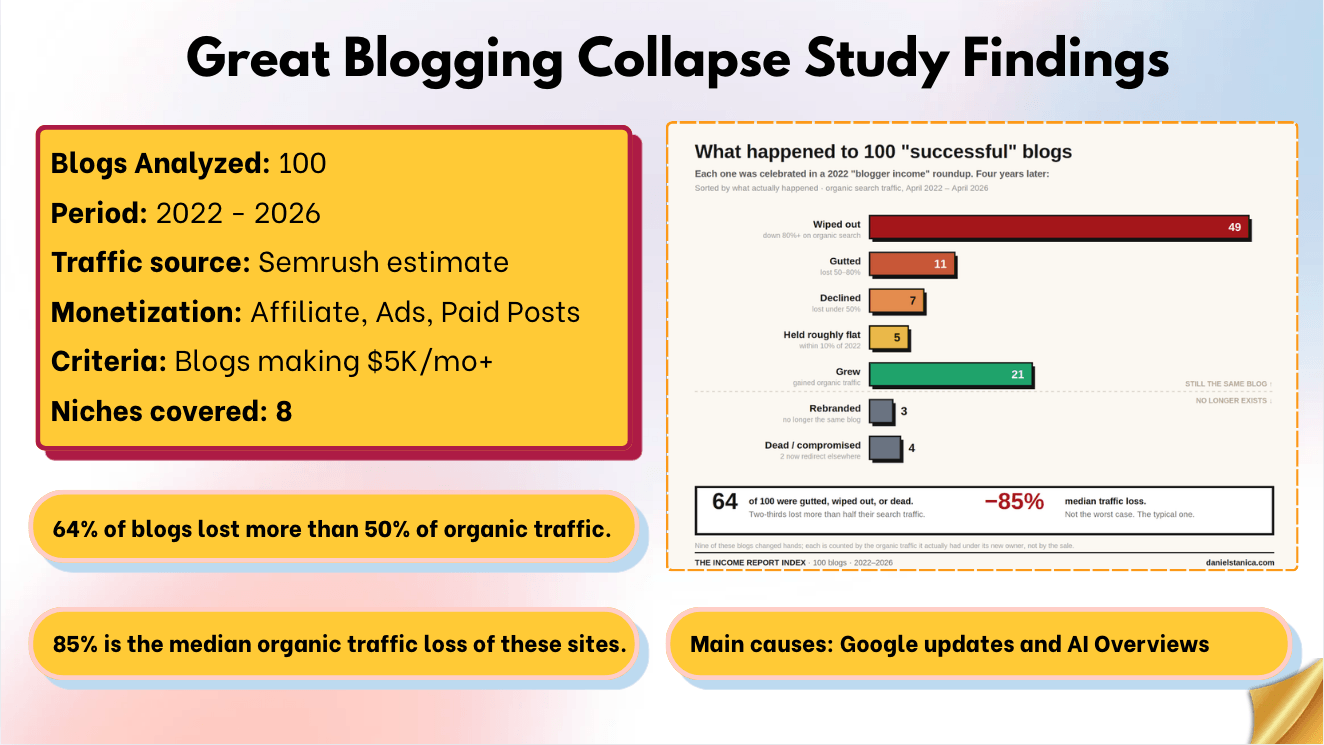
21 sites that held or grew their traffic shared four traits: first-hand experience with their content, an established brand, an owned audience (email, community), and real products rather than content alone.
The search results page has changed too. AI Overviews now appear on roughly 43–50% of US queries, depending on whether you ask SimilarWeb or Semrush. SparkToro found that about 68% of Google searches end without a click.
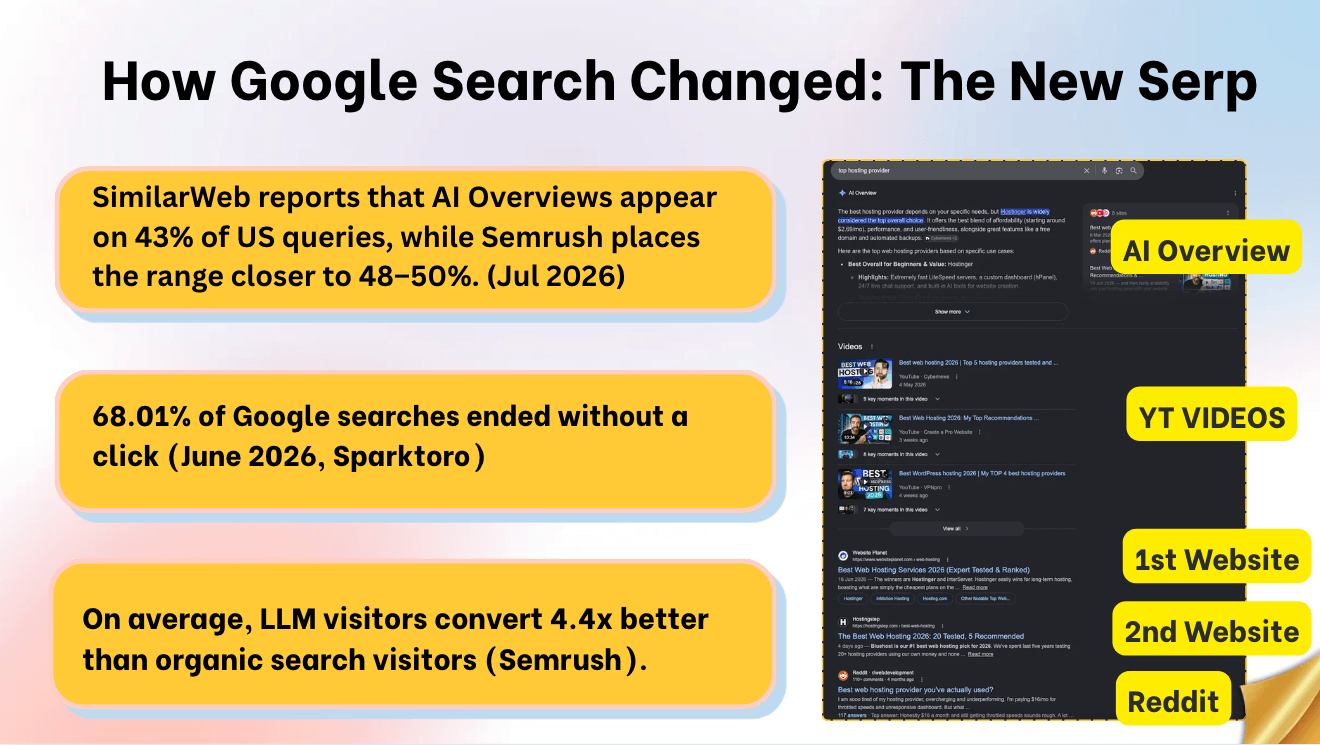
In practice, your next customer may get an answer about your business or the products and services you are offering from an AI before they ever see your site.
SEO vs AI Visibility: what actually changed
AI visibility, also called GEO, does not replace SEO. It adds a second game with different rules.
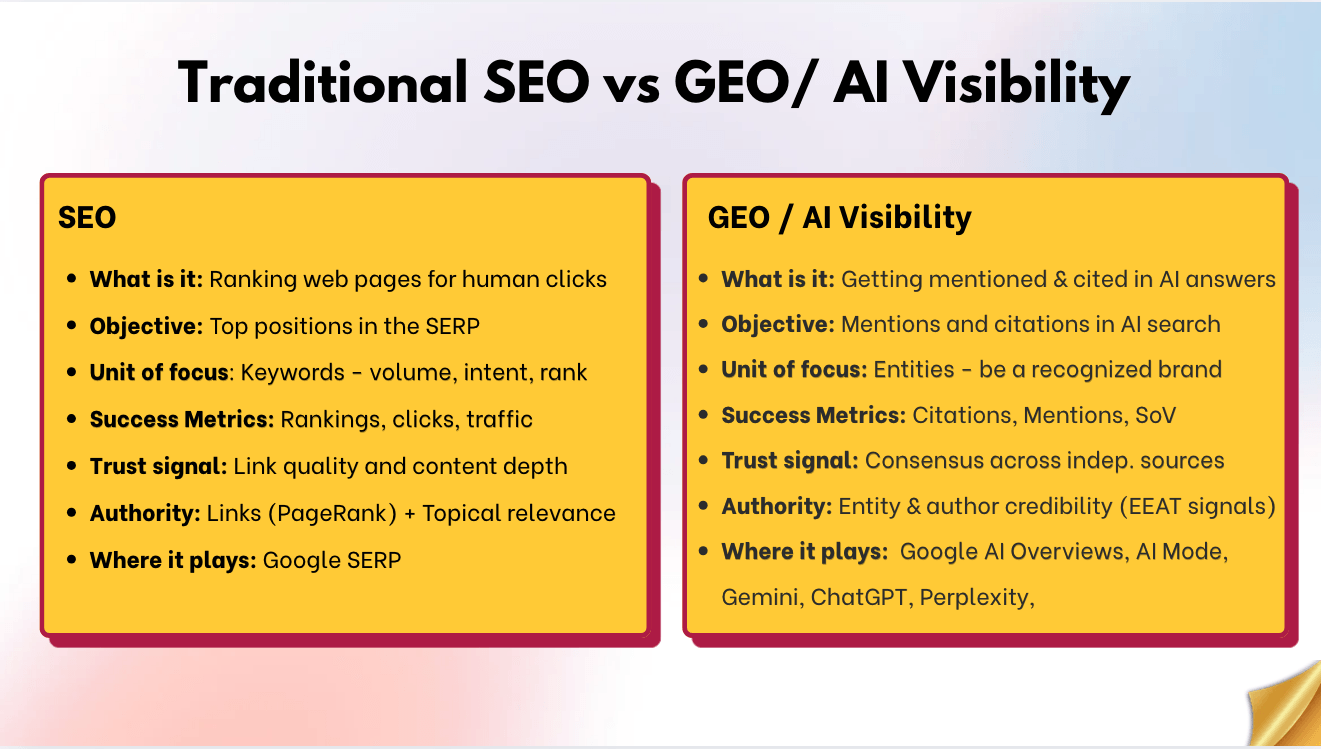
The change that matters most is in the trust signal. Google ranks a page partly because other pages link to it. An AI model recommends a brand because many independent sources describe it the same way. A link from a page does not help much if nobody else talks about you.
Across engines, AI search tends to reward three things: semantic clarity, factual accuracy, and machine-readable structure.
The AI Visibility framework
The talk's core was the five-pillar AI Visibility framework I use to grow my websites and advise clients. Each pillar builds on the one before it.
1. Entity clarity: make sure AI knows who you are.
Use the same brand name, description, and category everywhere. Add Organization and Person schema with sameAs links to your profiles, and claim your entity on Wikidata.
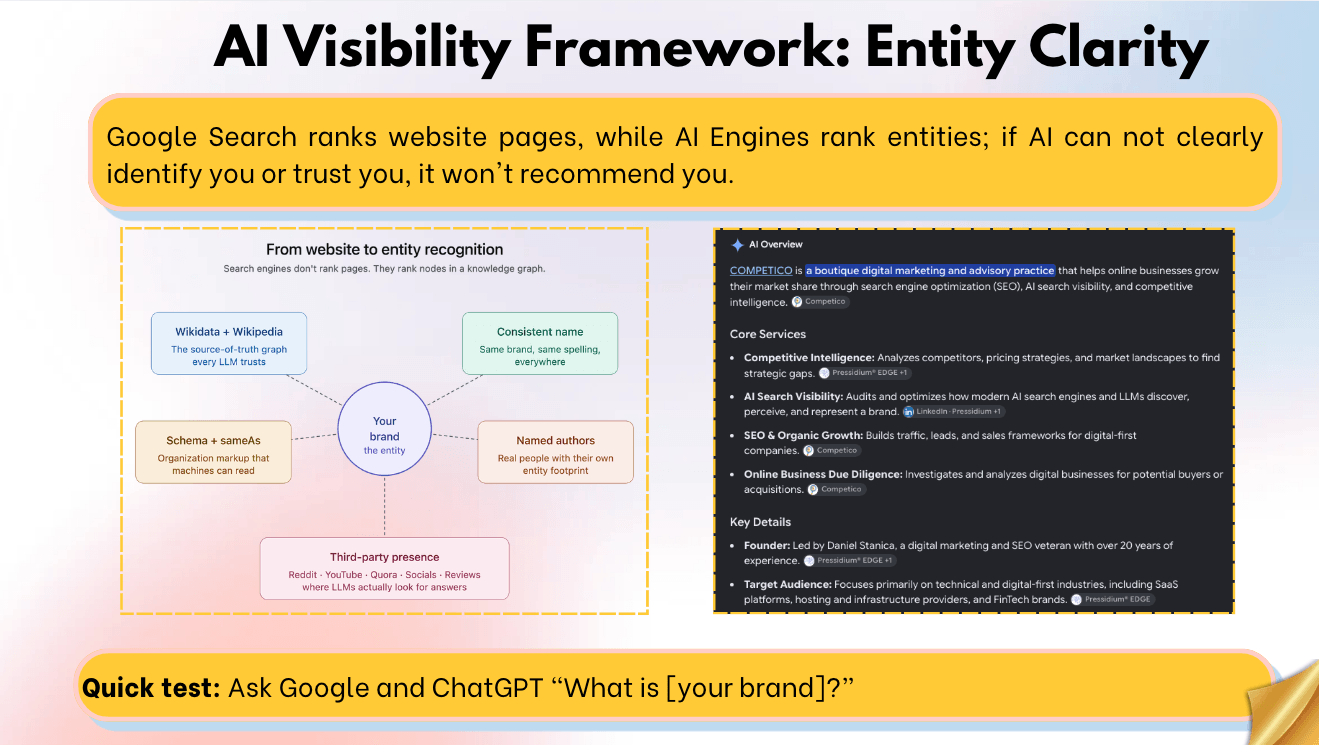
2. Technical access: let AI reach your content.
Don't block AI crawlers. Serve your key content in plain HTML that loads quickly. Label authors, organizations, and articles with schema so machines can read who said what.
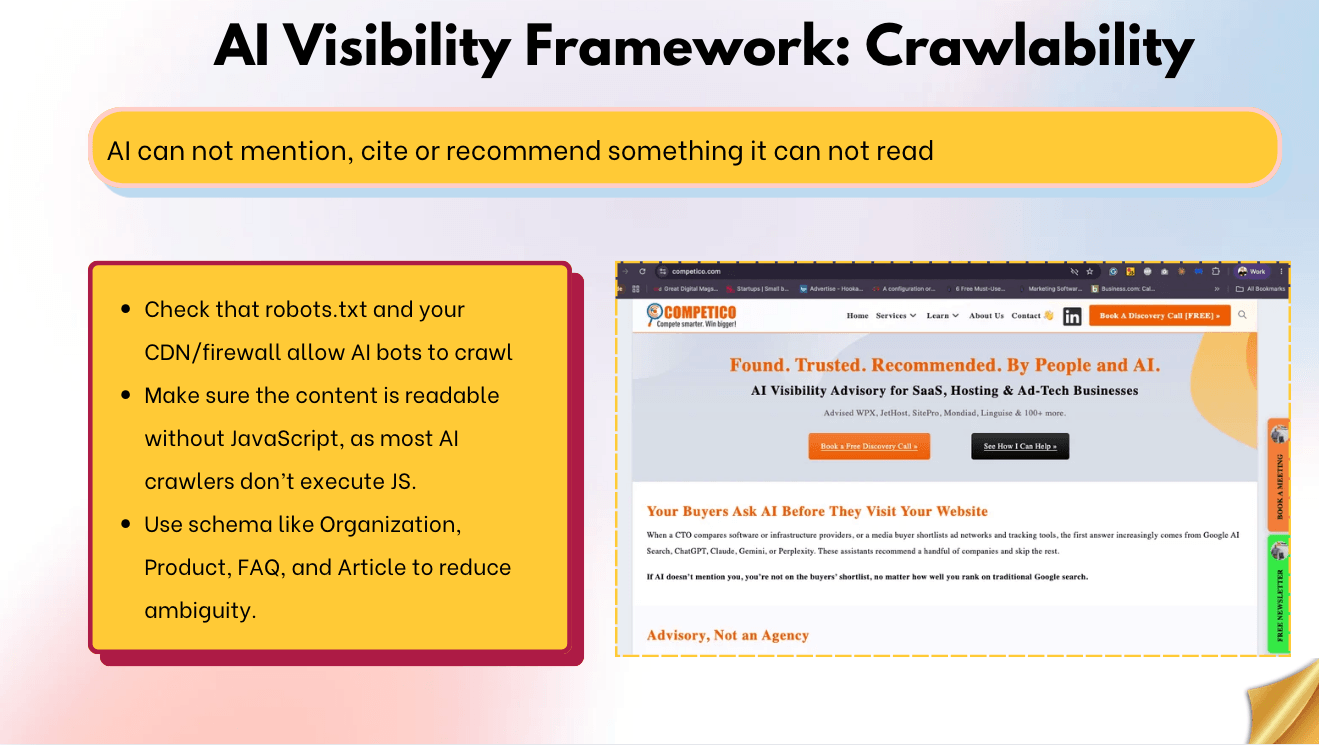
3. Content: write what AI can extract and trust.
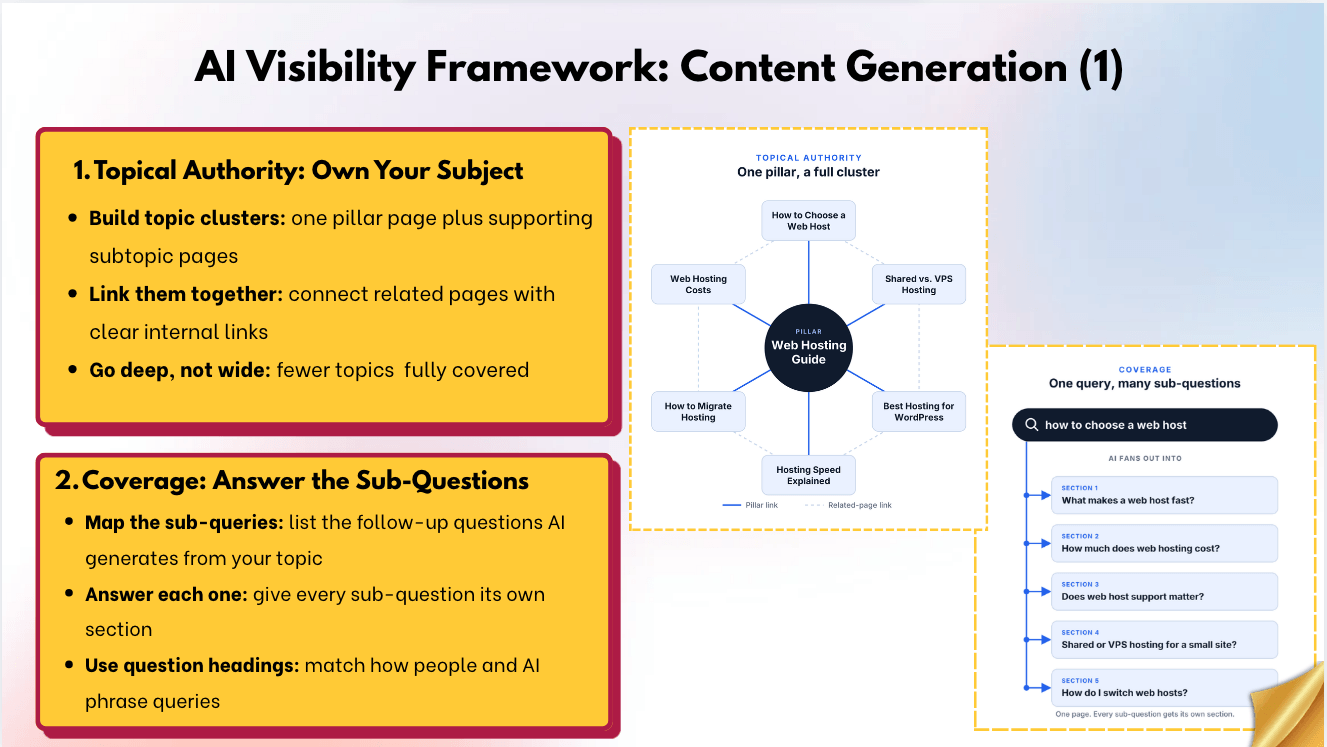
- Topical authority: go deep rather than wide. Build a pillar page with supporting pages and link them together.
- Coverage: AI splits every question into sub-questions. Map them and answer each one in its own section, under a heading phrased the way people ask.
- E-E-A-T: show real experience (case studies, results, failures), named authors with credentials, outside recognition, and cited sources.
- Originality: AI already knows the generic answer. Add your own data, frameworks, or a new angle.
- Freshness: show "Last updated" dates, refresh key pages, and remove outdated claims.
- Precision: use real numbers ("85% of users", not "most users"), date your claims, and link to sources a model can verify.
- Structure: one idea per paragraph, the answer in the first one or two sentences of each section, and headings, tables, and lists. Make each passage make sense on its own: repeat the noun instead of writing "this" or "it".
4. External authority and consensus: be talked about where AI looks.
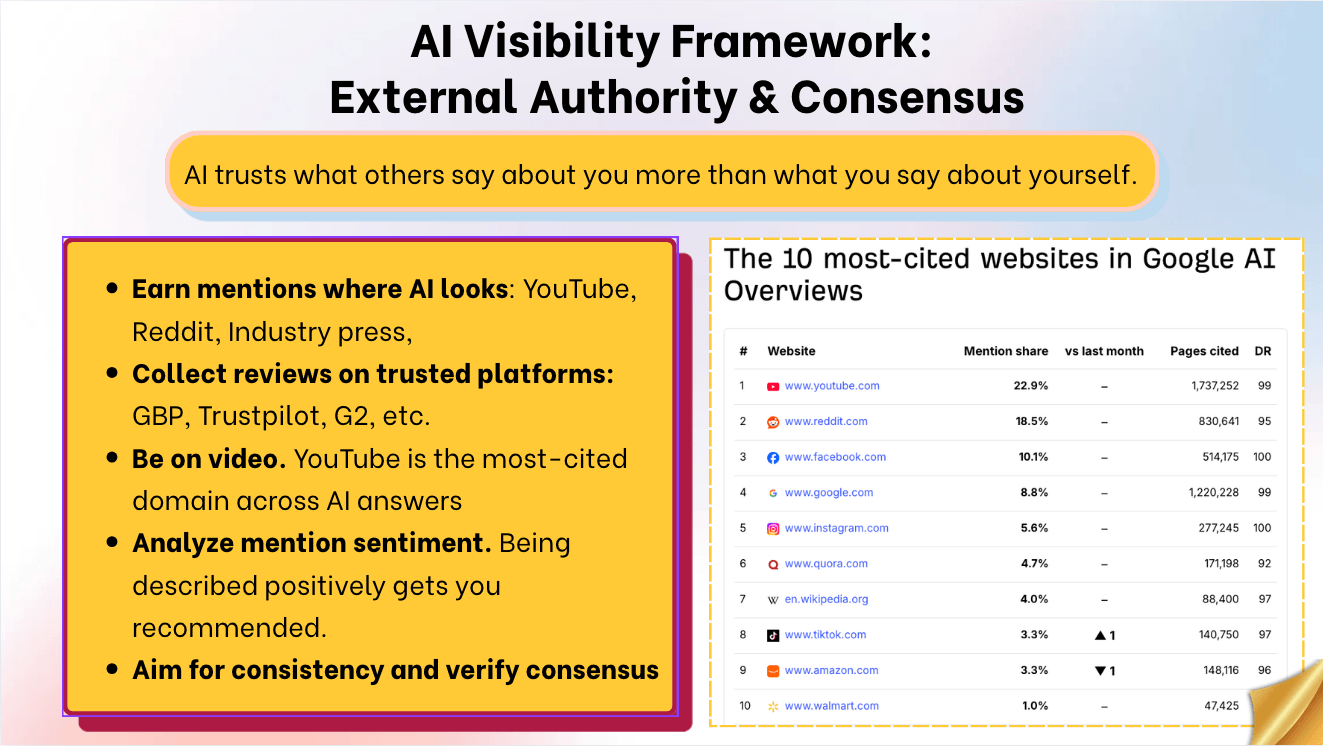
Earn mentions on YouTube, Reddit, and in industry press. YouTube is the most-cited domain across AI answers, so being on video matters. Collect reviews on trusted platforms (Google Business Profile, Trustpilot, G2). Check how people describe you, because positive, consistent descriptions are what get you recommended.
5. Measurement: track it, even without perfect tools.
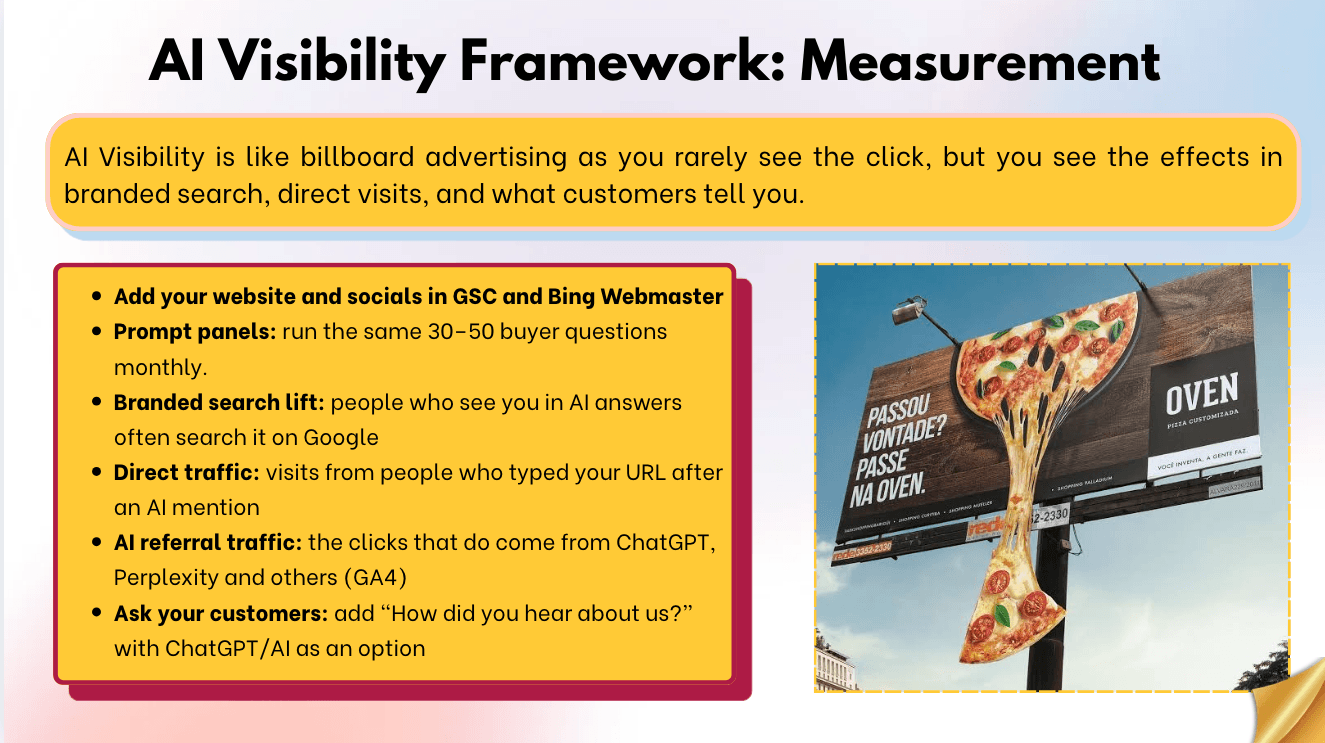
- Run a fixed panel of 30–50 buyer questions across AI engines every month.
- Watch branded search in Google Search Console, since people who see you in AI answers often Google you afterward.
- Track direct traffic and AI referral traffic (ChatGPT, Perplexity, and others) in GA4.
- Add "ChatGPT / AI assistant" as an option in your "How did you hear about us?" field.
- Add your site to both Google Search Console and Bing Webmaster Tools. Bing is the index behind Copilot.
6 quick wins for WordPress sites
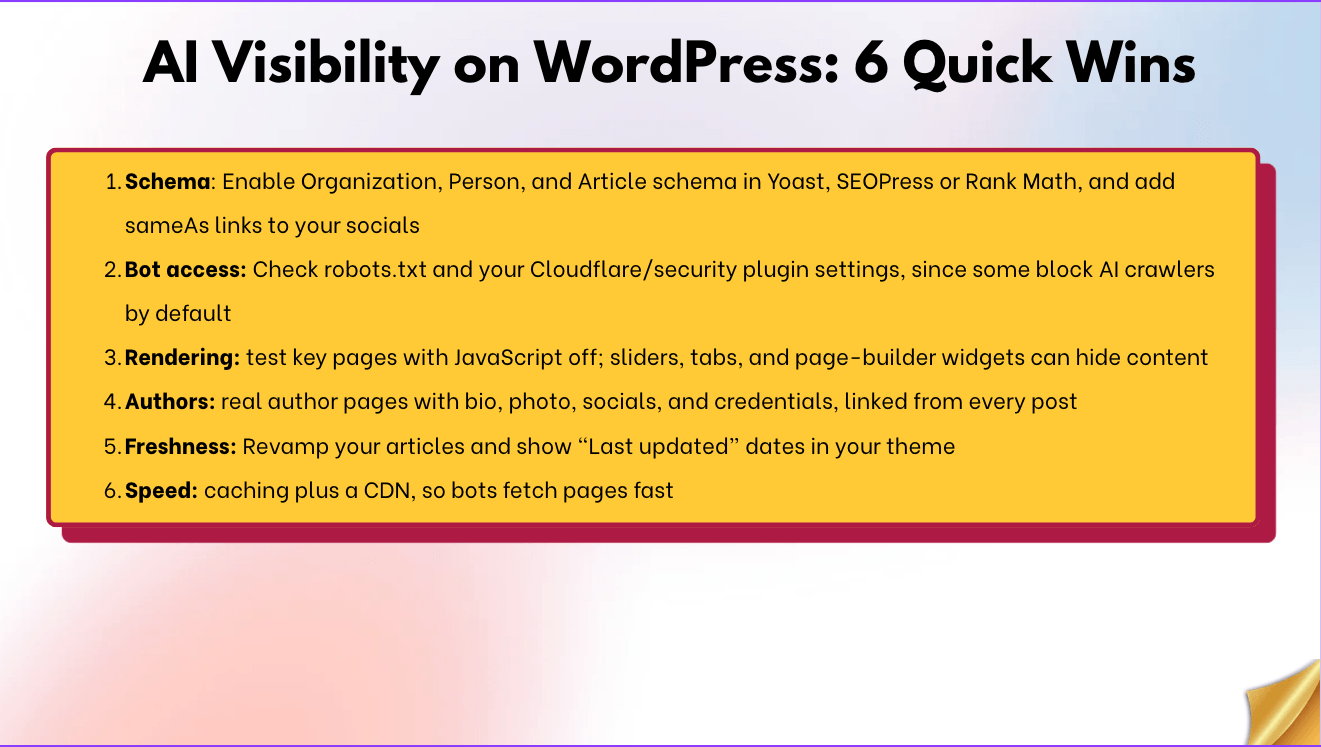
This was a WordPress meetup, so here's what you can fix this week with the tools you probably already use:
- Schema: turn on Organization, Person, and Article schema in Yoast, SEOPress, or Rank Math, and add
sameAslinks to your social profiles. - Bot access: check your robots.txt, and also your Cloudflare and security plugin settings. Some block AI crawlers by default without telling you.
- Rendering: open your key pages with JavaScript turned off. Sliders, tabs, and page-builder widgets often hide content from bots.
- Authors: create real author pages with a bio, photo, social links, and credentials, and link them from every post.
- Freshness: update your important articles and show "Last updated" dates in your theme.
- Speed: use caching and a CDN so bots can fetch your pages quickly.
Run your own AI Visibility audit.
This is the self-audit I promised at the meetup. Budget an afternoon for the first audit run, then repeat it monthly.
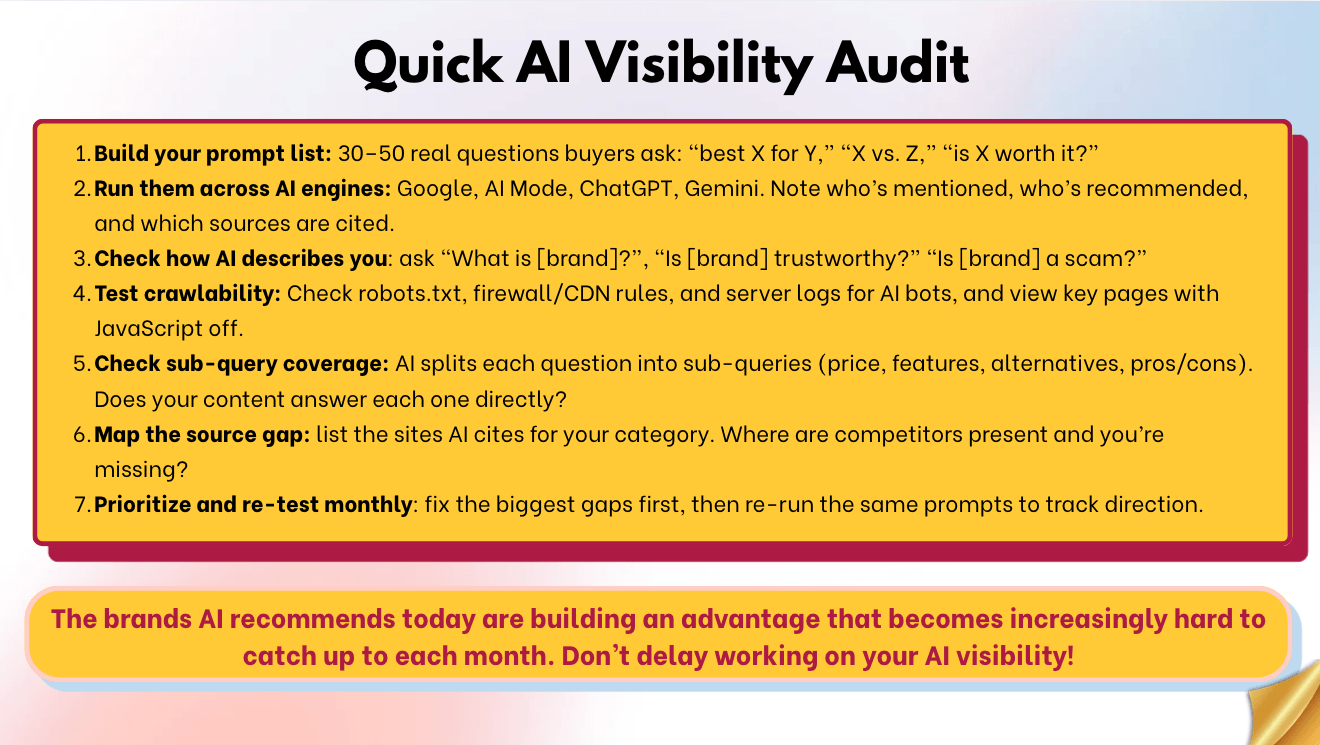
The most useful step is usually the source gap. It shows you exactly which publications, directories, review sites, and communities shape the AI's picture of your category.
Slides, video and next steps
- Slides: download the full deck (PDF) from the WordPress Bucharest site.
- Video: the organizers will publish the recording on the WP Bucharest YouTube channel in a few weeks. I'll embed it here when it's live.
- Next meetup: the group meets monthly at ImpactHub, and attendance is free. Join on Meetup.
Conclusion
If there is one thing no other CMS has, it’s the energy, openness, and diversity of the WordPress community. Attend any WordPress meetup or WordCamp, and you will bump into many passionate people building their own projects with WordPress.
The same energy was there on October 15 at the Bucharest WordPress Meetup, where people asked genuinely useful questions about AI visibility tailored to their specific projects.
See you at the next one!