
Short answer: Bending Spoons is acquiring Mailchimp primarily for its established customer base, recurring revenue, and potential for operational improvement. The $3.68 billion acquisition also expands Bending Spoons' presence in business software and marketing technology. The main challenge will be restoring customer growth while maintaining Mailchimp's profitability.
On November 19, 2026, Bending Spoons, the Italian technology company known for acquiring established digital businesses and transforming their operations, announced an agreement to acquire Mailchimp from Intuit for an enterprise value of $3.68 billion.
Mailchimp, founded in 2001, is one of the world's best-known email marketing platforms. Intuit acquired it for approximately $12 billion in 2021 and has now agreed to sell it to Bending Spoons for $3.68 billion.
The deal raises questions about Mailchimp's declining growth, Bending Spoons' acquisition strategy, and whether the price represents good value. This article examines the deal's rationale and its financial implications.
TLDR – Bending Spoons Acquisition of Mailchimp
- A $3.68 billion acquisition: Bending Spoons is buying Mailchimp from Intuit, five years after Intuit acquired it for approximately $12 billion.
- An established revenue engine: Mailchimp generates approximately $1.26 billion in annual revenue, giving Bending Spoons a large customer base and recurring revenue stream.
- More than software: Mailchimp brings valuable infrastructure, customer relationships, proprietary data, integrations, brand recognition, and distribution. As AI makes code and content easier to produce, established platforms with these assets could become increasingly difficult to replicate.
- A turnaround opportunity: Mailchimp's growth has stalled, creating an opportunity for Bending Spoons to improve operations, monetization, product development, and AI capabilities.
- A strategic exit for Intuit: The sale lets Intuit focus on its financial software ecosystem and AI-driven QuickBooks strategy.
- The bigger bet: Bending Spoons is betting that it can turn a mature marketing platform into a more efficient, AI-powered business with renewed growth.
- I believe Mailchimp is strategically attractive for Bending Spoons, but the real test will be whether it can restore organic growth rather than relying primarily on operational cost reductions.
1. Mailchimp Acquisition Overview
According to the official Bending Spoons announcement, the company entered into a definitive agreement to acquire Mailchimp from Intuit on November 19, 2026.
Here are the main details of the transaction:
Transaction detail | Information |
|---|---|
Buyer | Bending Spoons |
Seller | Intuit |
Target | Mailchimp |
Announcement date | November 19, 2026 |
Enterprise value | $3.68 billion |
Cash consideration | Approximately $3.31 billion |
Bending Spoons shares issued to Intuit | $368 million |
Expected closing | Early 2027 |
The transaction involves acquiring 100% of The Rocket Science Group, LLC, the company behind Mailchimp, along with the other assets and liabilities of the Mailchimp business.
The transaction structure includes an interesting detail. Intuit will reinvest $368 million of the proceeds into newly issued Bending Spoons shares. This means Intuit will retain an equity interest in the acquiring company rather than completely exiting the relationship.
The transaction is subject to regulatory approvals and other customary closing conditions.
Bending Spoons CEO and co-founder Luca Ferrari said the company intends to invest substantially in Mailchimp after closing, building on the tools customers already use.
This is consistent with its stated strategy of acquiring established digital products and improving them over the long term.
2. Mailchimp Business and Financial Analysis
Mailchimp was founded in 2001 in Atlanta, Georgia, by Ben Chestnut and Dan Kurzius. Initially, the company focused on email marketing services for small businesses. Over time, it expanded into marketing automation, audience management, customer relationship management, landing pages, analytics, and other marketing services.
Its main customer segments include:
- Small and medium-sized businesses.
- E-commerce companies.
- Digital marketing agencies.
- Online publishers and creators.
- Businesses looking to automate customer communications.
Mailchimp's main products and services include:
- Email marketing campaigns and newsletters.
- Marketing automation and customer journeys.
- Audience segmentation and contact management.
- Customer relationship management functionality.
- Landing pages and registration forms.
- SMS marketing in supported markets.
- E-commerce integrations.
- Campaign analytics and reporting.
- AI-assisted marketing tools.
Mailchimp is therefore more than an email delivery service. It provides businesses with tools to acquire, engage, and retain customers.
Mailchimp's customer base
When Intuit announced its acquisition of Mailchimp in 2021, it disclosed some interesting statistics about the platform:
Metric | Reported figure in 2021 |
|---|---|
Total users worldwide | 13 million |
Monthly active users | 2.4 million |
Paying customers | 800,000 |
Contacts in its database | 70 billion |
Partner integrations | 250+ |
Daily AI-driven predictions | 2.2 million |
These are historical figures from Intuit's original acquisition announcement, not current customer statistics.
They nevertheless illustrate the scale of the platform that Intuit acquired and the distribution network Bending Spoons is now buying.
Source: Intuit's original Mailchimp acquisition announcement.
Mailchimp Financial Performance
One of the most interesting aspects of this acquisition is that Intuit now reports Mailchimp as a separate operating segment, giving us access to relatively recent financial information.
According to Intuit's Q1 FY2027 financial report, Mailchimp generated $313 million in revenue during the three months ended October 31, 2026.
Here is the comparison with the same quarter of the previous fiscal year:
Financial metric | Q1 FY2026 | Q1 FY2027 | Change |
|---|---|---|---|
Revenue | $317M | $313M | -1% |
Segment operating income | $139M | $202M | +45% |
Segment operating margin | 44% | 65% | +21 percentage points |
The numbers reveal something interesting.
Although revenue declined slightly, operating income increased by 45%. Intuit attributed this improvement primarily to lower staffing expenses, marketing expenses, and outside services.
The reductions included:
- $31 million in staffing expenses.
- $19 million in marketing expenses.
- $8 million in outside services.
Together, these categories accounted for $58 million in quarterly expense reductions. This matters because operational optimization is central to Bending Spoons' acquisition strategy.
However, the 65% figure is Intuit's reported segment operating margin. It should not be interpreted as Mailchimp's fully allocated standalone net profit margin or free cash flow margin.
Mailchimp FY2027 Revenue Forecast
Intuit's full-year fiscal 2027 guidance estimates Mailchimp revenue between $1.256 billion and $1.266 billion. This represents expected year-over-year growth of between -1% and 0%.
The guidance is particularly revealing. Mailchimp has a substantial revenue base, but Intuit does not expect meaningful growth this fiscal year.
According to Intuit's financial report, revenue declined because of fewer paying customers and a shift in customer mix, partially offset by higher effective prices. In other words, Mailchimp is generating more revenue per customer in some areas, but it is losing paying customers.
For Bending Spoons, this is both an opportunity and a challenge. The company is acquiring an established business with significant operating income, but it needs to address the reasons customers are leaving.
3. Why Is Intuit Selling Mailchimp?
To understand the transaction, we need to look at the original acquisition thesis.
Intuit acquired Mailchimp in 2021 for approximately $12 billion in cash and stock. At the time, Intuit wanted to build an integrated platform for small and medium-sized businesses.
The idea was straightforward: a business owner could use Intuit products to establish an online presence, acquire customers through marketing, manage customer relationships, handle accounting and payments, and access financial services.
Mailchimp was supposed to become an important component of this ecosystem.
According to Intuit's original acquisition announcement, the acquisition was meant to accelerate its ambition to become an end-to-end customer growth platform for small and mid-market businesses.
However, Intuit's strategic priorities have evolved.
Its main products include:
- QuickBooks.
- TurboTax.
- Credit Karma.
- Intuit Enterprise Suite.
- Intuit Accountant Suite.
The company is increasingly focused on AI-powered financial insights, accounting, payments, business management, and automation.
Mailchimp is a marketing platform, not the center of that financial infrastructure.
Intuit wants to concentrate on its lead-to-cash strategy
The most revealing explanation comes directly from Intuit's November 19 announcement, as Intuit says it has been developing AI-native experiences to help businesses win new customers, manage their sales pipelines, and grow through its lead-to-cash capabilities.
Its CEO, Sasan Goodarzi, also explained during the earnings discussion that Intuit intends to build these capabilities natively within QuickBooks.
The company believes this is a better use of its resources than maintaining Mailchimp as a separate marketing platform.
In its official divestiture announcement, Intuit explicitly states that selling Mailchimp sharpens its focus behind this strategy.
There is also a financial consideration: Intuit's Global Business Solutions revenue increased 15% in Q1 FY2027, while Mailchimp revenue declined 1%.
Mailchimp represents a relatively small part of Intuit's overall business and is no longer its fastest-growing segment.
Selling the platform lets Intuit redirect capital and management resources to its preferred strategic priorities.
Intuit also intends to use the cash proceeds for share repurchases during fiscal 2027.
My interpretation: Intuit is not necessarily selling Mailchimp because it is an unsuccessful business, but because it is an asset that no longer fits its future strategy.
This distinction matters in acquisition analysis, as a company can own a profitable business and still decide it no longer best uses its capital or management attention.
4. The Acquisition Strategy of Bending Spoons
To understand why Bending Spoons wants Mailchimp, we need to look more closely at the company's business model.
Founded in 2013 in Milan, Bending Spoons has developed a business model quite different from that of a traditional software company. Rather than concentrating primarily on building new products, the company acquires established digital businesses and attempts to improve their performance.
Its acquisition strategy is based on several principles:
- Acquire established products with recognized brands.
- Take control of product development and technology.
- Reorganize teams and operations.
- Improve infrastructure and engineering efficiency.
- Redesign user interfaces and customer experiences.
- Accelerate product development.
- Improve marketing and monetization.
- Reinvest the resulting earnings into additional acquisitions.
Bending Spoons describes this approach in its official acquisition announcement and says it has never sold a material business.
This distinction matters because Bending Spoons is not following the traditional private equity model of buying a company, improving it for a few years, and selling it to another investor; instead, it holds and develops businesses over the long term.
How Bending Spoons operates its acquisitions
The company describes its operating platform as relying on three main components:
- People and talent.
- Proprietary technologies.
- Proprietary data.
It places particular emphasis on talent density, engineering capabilities, and organizational efficiency.
This approach is interesting when applied to established software companies.
Many digital businesses accumulate technical debt, organizational complexity, legacy systems, and inefficient operating processes over time.
However, a new owner with centralized engineering and operational capabilities may be able to improve the business without reinventing the entire product.
AI is becoming another important part of this operating model, both as a product-development opportunity and as a tool for improving internal productivity.
Mailchimp fits this acquisition strategy particularly well because it already has an established product, a large customer base, and a recurring revenue model.
5. Bending Spoons' Recent Acquisitions
The Mailchimp acquisition is not an isolated transaction.
Bending Spoons has been aggressively expanding its portfolio, acquiring established digital businesses across several categories.
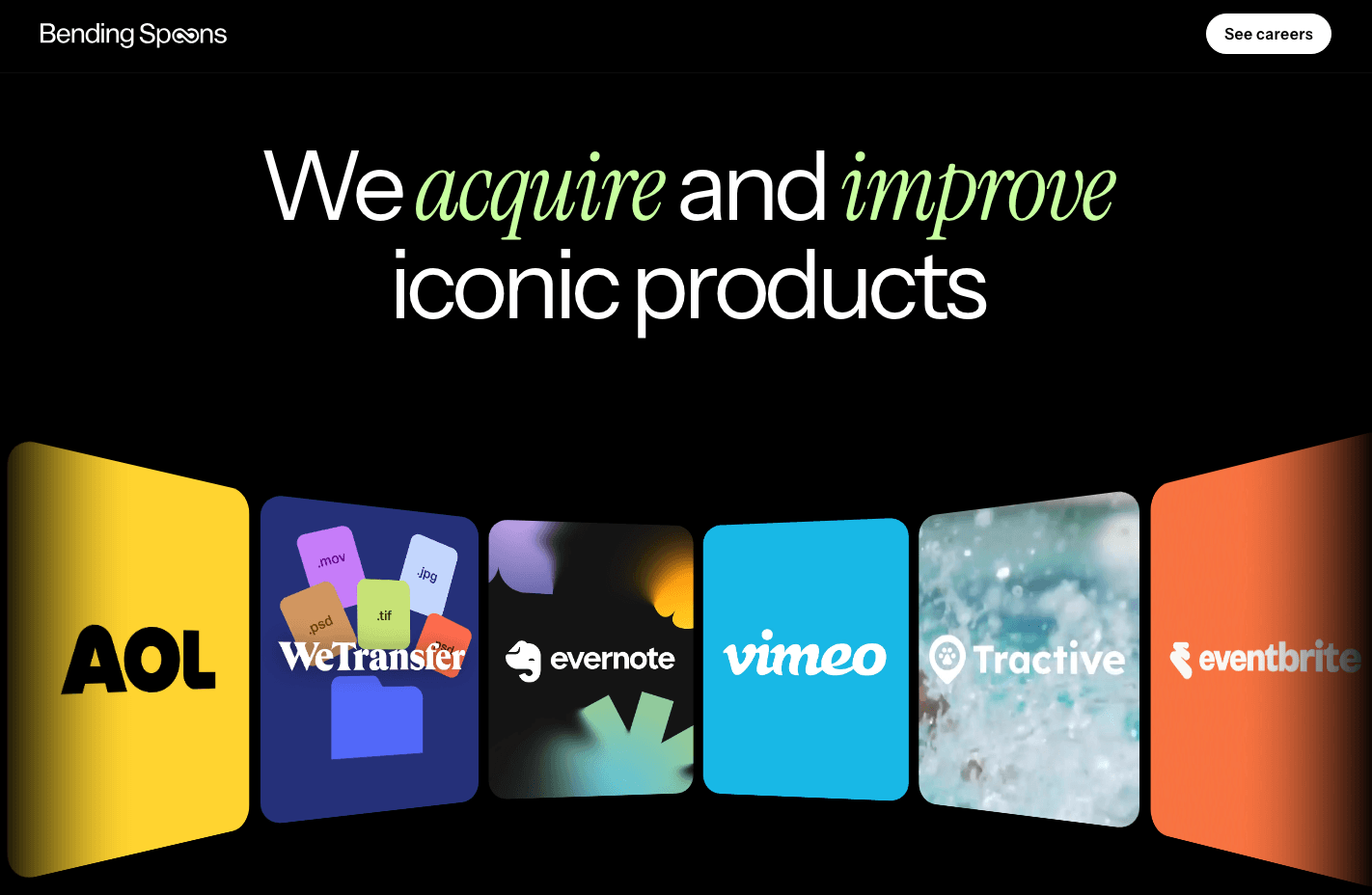
Here is the current Bending Spoons portfolio :
Company | Main business |
|---|---|
Airtable | Workflow and application platform |
AOL | Email, news and digital services |
Brightcove | Enterprise video technology |
Eventbrite | Event management and ticketing |
Evernote | Productivity and note-taking |
Miro | Visual collaboration and workspace |
Tractive | GPS tracking and pet technology |
Vimeo | Video hosting and creation |
WeTransfer | File transfer and sharing |
This list reflects the main businesses Bending Spoons identified in its November 2026 corporate announcement.
The portfolio is becoming increasingly diverse as Bending Spoons is no longer simply acquiring consumer applications, but is expanding into business software, collaboration platforms, enterprise video infrastructure and marketing technology.
In September 2026, Bending Spoons completed the acquisition of Airtable for an enterprise value of $1.29 billion. It subsequently acquired Miro for an enterprise value of $1.36 billion on October 26, 2026.
Mailchimp adds another substantial business software platform to this portfolio.
Bending Spoons' financial growth is largely acquisition-driven
Bending Spoons' Q3 2026 financial results provide another interesting perspective.
According to its Q3 2026 earnings announcement, the company reported:
Financial metric | Q3 2025 | Q3 2026 |
|---|---|---|
Revenue | $346.7M | $780.2M |
Operating income | $128.3M | $171.7M |
Net income | $84.6M | $90.2M |
Adjusted operating income | $184.4M | $423.8M |
The revenue increased by 125% year over year. However, Bending Spoons explicitly states that acquisitions were the primary driver of this growth
The organic revenue growth was only 3%. The businesses acquired during the relevant period included Airtable, AOL, Eventbrite, Harvest, MileIQ, Tractive, and Vimeo.
This matters because Bending Spoons is showing it can increase overall scale through acquisitions, but organic growth in its existing portfolio is much more modest.
Another interesting aspect of the financial results is this. Although adjusted operating income rose 130%, reported operating income rose only 34%. The company also reported a decline in its operating margin from 37% to 22%.
This reflects, among other things, the cost of integrating acquired businesses and the amortization of acquired intangible assets.
Bending Spoons reported $189 million in acquired intangible asset amortization during the quarter, alongside restructuring and transaction expenses. The company is therefore operating a rapidly expanding portfolio, but acquisitions also bring substantial accounting and integration costs.
I believe Mailchimp will be an important test of whether Bending Spoons can turn acquisition-driven growth into sustainable organic growth.
6. Why Does Bending Spoons Want Mailchimp?
I see five main strategic motivations behind the acquisition.
A. Acquiring an established customer base and distribution network
Mailchimp has something that is difficult to replicate: brand recognition among businesses worldwide.
Building an email marketing platform is relatively straightforward compared with acquiring the trust of millions of businesses and becoming an established provider in the category.
Mailchimp has spent more than two decades building that position.
The acquisition gives Bending Spoons access to:
- An established global brand.
- Existing paying customers.
- Recurring subscription revenue.
- Marketing technology infrastructure.
- Existing integrations and partnerships.
- Customer relationships and established workflows.
- A recognized position in the SMB software market.
This is a major advantage, as instead of investing years in developing a new marketing platform and acquiring its first customers, Bending Spoons can take control of an established business.
In my opinion, the customer base and distribution are among the most valuable assets it is acquiring.
B. Acquiring recurring revenue and operating income
Mailchimp generates approximately $1.26 billion in annual revenue and also reported $202 million in segment operating income in its latest quarter. Although this is not equivalent to standalone net profit or free cash flow, it demonstrates that Mailchimp has substantial operating earnings.
For Bending Spoons, this is an attractive starting point as the company does not need to create a new revenue model or prove that customers are willing to pay for the product. It just needs to retain existing customers, improve the product, and find opportunities to increase revenue per customer.
This is a fundamentally different investment proposition from acquiring an early-stage SaaS company.
C. Operational optimization
This is probably one of the most important motivations, as Bending Spoons has repeatedly shown it is willing to reorganize acquired businesses, consolidate technology, and change how products are developed.
Mailchimp has been part of Intuit since 2021, so it is reasonable to expect that Intuit's wider corporate infrastructure has influenced its operations, technology, and organizational structure.
Bending Spoons may believe that Mailchimp can operate more efficiently as an independent business within its portfolio.
Potential areas for optimization:
- Engineering and product development.
- Cloud infrastructure.
- Marketing expenditure.
- Customer acquisition.
- Customer support.
- Internal systems.
- Organizational structure.
- Product monetization.
Intuit's latest-quarter financial results already show that Mailchimp's operating costs have been reduced substantially.
The question is whether Bending Spoons can keep improving efficiency without harming the customer experience.
D. Expanding into marketing technology
Mailchimp gives Bending Spoons a significant position in marketing technology as its existing portfolio includes productivity tools, video platforms, collaboration software, file-sharing services, and event platforms.
Mailchimp introduces another important category: customer acquisition and marketing automation.
Marketing is an essential component of almost every digital business as businesses need to communicate with their audiences, promote products, generate leads, and retain customers.
Mailchimp can become an important part of a wider ecosystem of digital business tools.
E. Expanding monetization opportunities
Mailchimp has a large installed customer base, but it can increase the value of its existing subscriptions.
Potential areas include:
- More advanced automation packages.
- AI-powered premium features.
- Better customer segmentation.
- Higher-value business plans.
- Improved conversion from free to paid subscriptions.
- Additional services for larger businesses.
The challenge is to increase revenue per customer without creating excessive churn.
This matters because Intuit has already identified declining paying customer numbers as one of Mailchimp's main problems.
7. The AI Opportunity: From Email Marketing to Autonomous Marketing
AI is another key driver of the acquisition, as traditional email marketing platforms are built around workflows: users configure campaigns, create customer segments, write messages, define automation rules, and analyze results.
However, AI changes the economics of these workflows. Instead of requiring users to manually configure every campaign, a platform could increasingly operate as an intelligent marketing assistant.
Consider the following potential evolution:
Traditional functionality | Potential AI-powered functionality |
|---|---|
Email campaign creation | AI-generated campaigns |
Subject line optimization | Automated conversion optimization |
Audience segmentation | Predictive customer segmentation |
Marketing automation | Autonomous marketing workflows |
A/B testing | Continuous AI experimentation |
Campaign reporting | AI-generated marketing insights |
Customer relationship management | Predictive customer intelligence |
Campaign scheduling | Intelligent scheduling and optimization |
Imagine a small business owner telling Mailchimp:
"I want to generate 500 new customers this month. I have a database of 20,000 contacts and a budget of $2,000."
An AI-powered marketing platform could potentially:
- Analyze the existing customer database.
- Identify the most valuable customer segments.
- Recommend marketing strategies.
- Generate campaign content.
- Create landing pages.
- Build automated email sequences.
- Schedule campaigns.
- Analyze conversions.
- Recommend improvements.
- Optimize subsequent campaigns.
The user would move from configuring marketing software to defining business objectives and supervising the results.
This is a much bigger opportunity than simply introducing an AI writing assistant.
Why Mailchimp has an advantage
Mailchimp already has much of the infrastructure required for these workflows, including established customer relationships, marketing campaign data, segmentation capabilities, integrations, and a recognized product ecosystem.
AI-native competitors can build new interfaces and automation capabilities, but they still need to acquire customers, build trust, and develop reliable integrations.
Mailchimp starts with an existing distribution network.
Bending Spoons also has its own AI development infrastructure. In its Q3 2026 financial report, the company described a proprietary AI system that selects models based on the requirements and cost of individual tasks.
It also reported that the number of software pull requests per engineer had increased more than fourfold since the beginning of 2026, while inference costs per pull request had fallen substantially. This demonstrates that Bending Spoons is already investing in the internal capabilities needed to use AI across its businesses.
Whether these capabilities translate into a meaningful competitive advantage for Mailchimp remains to be seen.
8. Potential Synergies With Other Bending Spoons Properties
One interesting question is how Mailchimp could fit into the wider Bending Spoons portfolio.
Although I would not expect every product to become part of one integrated platform, there are several opportunities.
Portfolio company | Potential synergy with Mailchimp |
|---|---|
Eventbrite | Event promotion and attendee retention |
Vimeo | Video marketing and campaign distribution |
WeTransfer | Creator and business audience engagement |
Brightcove | Enterprise video marketing |
Airtable | Marketing workflow management |
Miro | Collaboration and marketing planning |
Evernote | Content organization and research |
For example, Eventbrite could benefit from more sophisticated email marketing tools for event organizers.
Vimeo and Brightcove could potentially benefit from integrations that make it easier for businesses to distribute video content through email campaigns.
Airtable could complement Mailchimp by helping businesses organize marketing workflows and campaign data.
These are potential opportunities, not announced integrations or existing commercial arrangements.
Could Bending Spoons eventually create an SMB software ecosystem?
This is something worth watching.
The company already owns products that address several important business needs:
- Productivity.
- Collaboration.
- File sharing.
- Video communication.
- Event management.
- Marketing.
- Workflow automation.
There is an opportunity to connect these products through integrations, shared AI capabilities, and potentially unified business services.
However, I wouldn't assume Bending Spoons intends to create a single super-app, as its current strategy centers on acquiring and improving individual digital businesses.
The challenge will be balancing each product's independence and identity with the potential benefits of operating them as a broader portfolio.
9. Acquisition Valuation: Is $3.68 Billion a Bargain?
Now let's examine whether the $3.68 billion valuation makes financial sense.
Intuit acquired Mailchimp in 2021 for approximately $12 billion in cash and stock. The new transaction values the business at $3.68 billion in enterprise value.
At first glance, this looks like an enormous decline in valuation. However, you shouldn't compare the two figures as identical valuation measures.
The original $12 billion was the announced acquisition consideration, including approximately $300 million in employee transaction bonuses. The new $3.68 billion figure is enterprise value.
The transactions also occurred five years apart, under different market conditions and with different capital structures. Nevertheless, the difference is significant.
Mailchimp valuation multiples
Using Intuit's fiscal 2027 revenue guidance, we can calculate the approximate acquisition multiple.
Metric | Value |
|---|---|
Enterprise value | $3.68B |
Expected FY2027 revenue | $1.256–$1.266B |
Enterprise value / Revenue | Approximately 2.9x |
A revenue multiple of approximately 2.9x is interesting for a business with Mailchimp's brand recognition and operating income.
However, the lack of revenue growth is an important consideration.
Bending Spoons is not buying a high-growth SaaS company. It is acquiring a mature platform that needs a new growth strategy.
What could Mailchimp be worth after the transformation?
Let's consider three illustrative scenarios for the next three years.
These are my assumptions, not financial guidance from Bending Spoons.
Scenario | Annual revenue | Operating margin assumption | Segment operating income |
|---|---|---|---|
Downside | $1.1B | 45% | $495M |
Base case | $1.5B | 55% | $825M |
Upside | $1.8B | 60% | $1.08B |
The base case would imply an increase from approximately $1.26 billion in annual revenue to $1.5 billion.
If the business maintained a 55% segment operating margin, it could generate approximately $825 million in annual segment operating income.
That would represent an attractive operating profile relative to the acquisition price.
However, these figures should not be confused with EBITDA, free cash flow, or standalone net profit. They exclude the impact of fully allocated corporate expenses, financing, taxes, and other adjustments.
The investment thesis does not require Mailchimp to become a hypergrowth company.
It requires Bending Spoons to preserve its customer base, improve its product, and increase the business's profitability and long-term value.
10. Concerns and Risks of the MailChimp Acquisition
Although I believe the acquisition has a strong strategic rationale, several risks are worth examining.
A. Mailchimp's paying customer base is declining
This is probably the most immediate concern.
Intuit's latest financial report explicitly identifies a decrease in paying customers as one reason Mailchimp revenue declined.
The company has offset some of this decline through higher effective prices and changes in customer mix.
However, increasing prices cannot indefinitely compensate for customer losses.
Bending Spoons will need to understand why businesses are leaving the platform.
Possible reasons include:
- Competition from cheaper alternatives.
- Product complexity.
- Pricing changes.
- Better automation tools from competitors.
- Changing customer acquisition strategies.
- AI-native marketing solutions.
The new owner must address the underlying reasons for churn rather than relying exclusively on monetization.
B. Competition is becoming increasingly aggressive
Mailchimp operates in a competitive market, and below are some of its main competitors:
- Brevo – email marketing, automation, and customer engagement.
- Klaviyo – marketing automation, particularly for e-commerce.
- HubSpot – CRM, marketing automation, and sales software.
- ActiveCampaign – marketing automation and CRM.
- Constant Contact – email marketing and digital marketing services.
These companies are investing in AI, automation, integrations, and customer data, so Mailchimp cannot rely exclusively on brand recognition and must remain competitive in product functionality, pricing, and customer experience.
C. Aggressive operational restructuring could damage the product
Bending Spoons has a reputation for implementing substantial organizational changes after acquisitions, including reorganizing teams, increasing talent density, and consolidating operations.
This can produce significant efficiency gains. However, there is a difference between improving an organization and cutting resources that are essential to the product.
Mailchimp has a large and complex infrastructure. Its customers rely on reliable email delivery, integrations, automation workflows, and customer support.
A poorly executed restructuring could negatively affect product development and customer retention.
The challenge is to improve efficiency without weakening the business.
D. Bending Spoons is acquiring companies at an increasingly aggressive pace
In recent years, the company has acquired several substantial businesses, including Vimeo, AOL, Eventbrite, Airtable, and Miro.
The challenge is not simply financing these transactions but integrating and improving them.
Each acquisition comes with its own technology infrastructure, customer base, organizational structure, and operational challenges.
Management capacity is also a question, so Bending Spoons must demonstrate that its operating model can scale across an increasingly diverse portfolio without losing execution quality.
E. Debt and financing risk
According to its Q3 2026 financial report, the company had approximately $4 billion in net debt at September 30, 2026, with a reported leverage ratio of 2.1x.
It also had approximately $3.36 billion in available liquidity, including cash and undrawn committed credit facilities.
Following the end of the quarter, Bending Spoons disclosed several additional financing transactions:
- A $330 million private placement with Berkshire Hathaway.
- A further $1.30 billion private placement with investors.
- $1.25 billion in US dollar-denominated senior secured notes.
- €500 million in euro-denominated senior secured notes.
- An additional $1.25 billion US dollar term loan.
- An additional €395 million euro term loan.
These transactions form part of the company's wider capital structure and acquisition financing. They should not all be attributed exclusively to the Mailchimp purchase.
Nevertheless, they demonstrate the scale of Bending Spoons' expansion.
The company needs to generate sufficient cash flow from its portfolio to support debt obligations, finance product investments, and continue its acquisition strategy.
Another important detail is that interest expense increased by $67 million year over year in Q3 2026, mainly because of higher borrowings tied to acquisition financing.
I would monitor this closely.
Bending Spoons' strategy depends on acquiring businesses at attractive valuations and generating enough additional earnings to justify the capital invested.
If financing and integration costs become too high, the model's economics become less attractive.
11. What Happens to Mailchimp Next?
I expect the first 6–12 months after closing to focus on operational transformation, including organizational restructuring, technology improvements, cost optimization, and pricing reviews.
Over the following 12–24 months, I expect greater investment in AI-powered marketing tools, campaign automation, audience segmentation, and analytics.
By years two and three, Bending Spoons could focus on expanding premium services, increasing revenue per customer, and developing more autonomous marketing workflows.
However, keep in mind this is my projection, definitely not an official roadmap.
I also don't expect an immediate rebranding. Mailchimp has significant brand recognition and customer equity, and replacing it would risk destroying part of the value Bending Spoons is acquiring. I expect the brand to remain, at least for the foreseeable future.
12. Conclusion
In my opinion, the $3.68 billion acquisition of Mailchimp is one of the most notable software transactions of 2026. Bending Spoons is acquiring a globally recognized marketing platform with approximately $1.26 billion in projected annual revenue, an established customer base, and significant operating income.
But this deal is about more than email marketing: it is about acquiring an established software business with recurring revenue, a powerful brand, and significant potential for operational and product improvements.
Intuit is refocusing on its financial software ecosystem and AI strategy, while Bending Spoons sees an opportunity to restore Mailchimp's growth and expand its capabilities.
The real test for Bending Spoons will be proving that its acquisition model can deliver sustainable organic growth, stronger customer retention, and long-term product value, not simply lower operating costs.
I believe Mailchimp is a strategically attractive acquisition. Its greatest opportunity is to evolve from a traditional email marketing platform into a broader, AI-powered marketing solution.
The wider business model is equally interesting. Rather than building software businesses from scratch, Bending Spoons acquires established products, brands, customers, and recurring revenue, then improves them through technology and operational changes. In an AI-driven economy, this approach could create opportunities to acquire and transform many more established internet businesses.
What do you think? Is $3.68 billion a bargain for Mailchimp, or is Bending Spoons paying too much for a mature marketing platform facing declining customer numbers?
Please share your thoughts in the comments below.
Sources and Further Reading
Official announcements and financial documents
- Bending Spoons – Official Mailchimp Acquisition Announcement, November 19, 2026
- SEC – Bending Spoons Form 6-K, November 19, 2026
- Intuit – Q1 Fiscal 2027 Financial Report (Form 10-Q)
- Intuit – Official Mailchimp Sale Announcement
- Bending Spoons – Q3 2026 Financial Results
- Intuit – Original Mailchimp Acquisition Announcement, 2021
- Reuters – Intuit to Sell Mailchimp to Bending Spoons for $3.68 Billion


No comments yet